


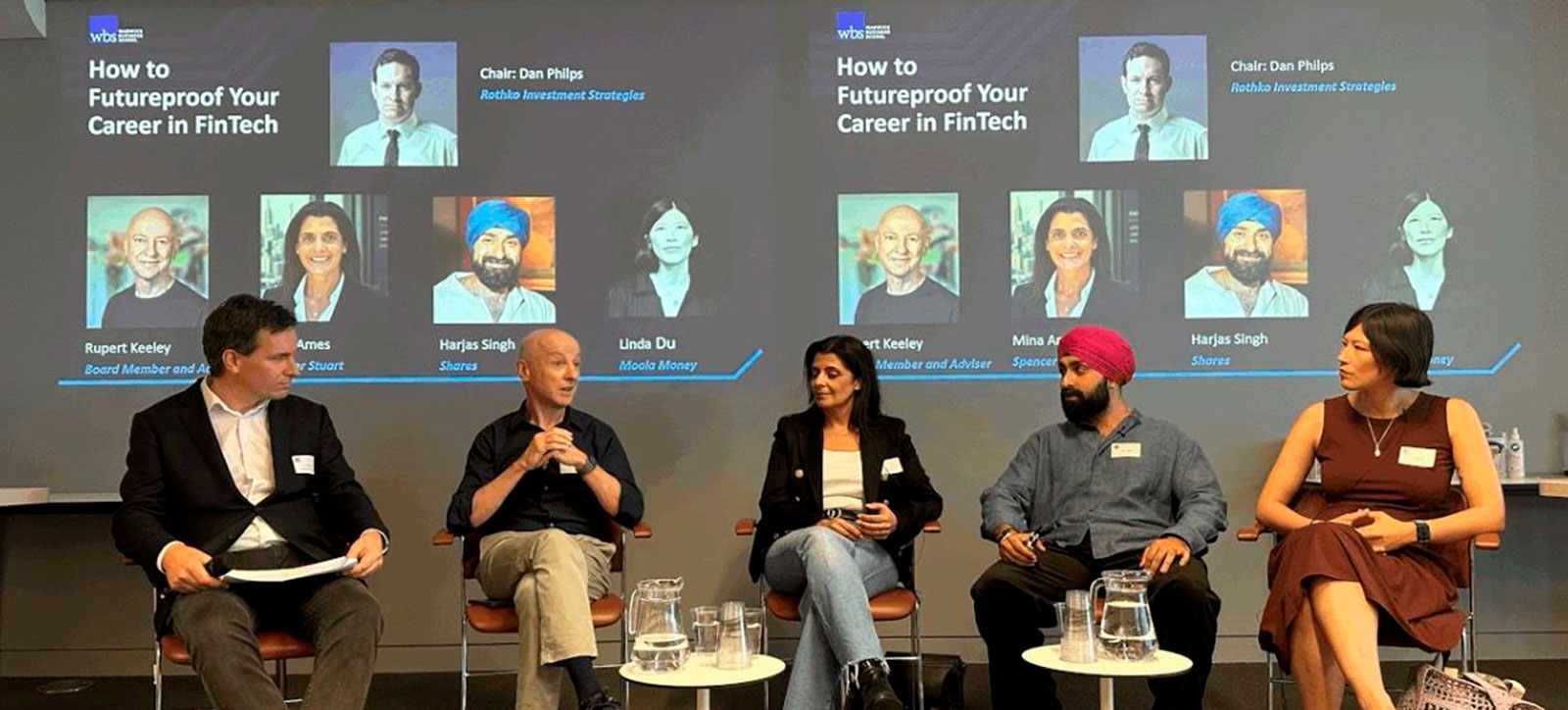
Futureproofing: A panel discussion between industry figures (l to r) Dan Philps of Rothko Investment Strategies; Rupert Keeley, Adviser and Board Member for Financial Services and Payments; Mina Ames of Spencer Stuart; Harjas Singh of Shares; and Linda Du of Moola Money
The financial services industry is grappling with skills challenges as artificial intelligence reshapes jobs at pace, according to speakers at the FinTech Futures Forum held at WBS London at The Shard.
Gregg Hutchings, keynote speaker and Programme Director at the Financial Services Skills Commission (FSSC), warned that demand for talent is “vastly outstripping supply” in critical areas, particularly machine learning and adaptability.
Drawing on the Commission’s latest Annual Skills Report, he pointed to a 28 per cent shortfall in AI-related skills and a 47 per cent gap in the key behavioural skillset of adaptability.
The forum – convened by Warwick Business School’s Gillmore Centre for Financial Technology with the WBS Alumni Finance Network – highlighted how these gaps are being driven not simply by growth in fintech, but by a fundamental redesign of work itself. Hutchings noted that financial technology has expanded by 29 per cent year-on-year, as the nature of tasks shifts from human-led processes to AI-supported ‘augmentation’ and ultimately to autonomous execution.
“Work is increasingly being done by people using AI agents,” he told an audience of students on Warwick Business School’s MSc Financial Technology and industry professionals.
As a result, he added, analytical and governance capabilities are becoming core competencies for the modern financial workforce.
From specialisation to hybrid skills
Drawn from the world of fintech, speakers at the forum repeatedly stressed that traditional career silos such as the division between finance professionals and engineers are breaking down under the influence of AI tools.
Harjas Singh, Co-founder and Chief Product Officer of investment platform Shares, argued that fintech’s historic model of pairing domain experts with technical specialists is giving way to more fluid, interdisciplinary roles. “There’s not a clear delineation of roles anymore,” he said, noting that product professionals can now engage directly with operational and technical challenges using AI-assisted tools.
This shift is lowering barriers to entry while simultaneously raising expectations around adaptability. Mr Singh encouraged would-be entrants to “be comfortable with discomfort”, describing how new technologies are forcing workers to continuously reskill and operate beyond their traditional job descriptions.
In a lively panel discussion chaired by Gillmore Centre Honorary Research Fellow Dan Philps, delegates heard that this change is democratising expertise. Skills that were once tightly held – coding, financial modelling or analytics – are increasingly accessible via AI, allowing workers to develop complementary capabilities across disciplines.
Mina Ames, of executive search firm Spencer Stuart, echoed this view, arguing that technical proficiency alone is no longer sufficient.
“Don’t just be a coder,” she said. “You have to bring a narrative that links technology with commercial outcomes.”
Adaptability as the missing capability
Despite the proliferation of digital tools, speakers suggested that the most acute skills gaps are behavioural rather than technical. Mr Hutchings’ data on the adaptability shortfall was reinforced by panellists who framed resilience, curiosity and openness to change as essential attributes.
Linda Du, CEO and Co-founder of financial planning platform Moola Money, highlighted fintech as a “buoyant ecosystem” with diverse entry points – from compliance to content engineering – but cautioned that navigating it requires clarity of purpose and emotional resilience.
“A lot of this is about feeling comfortable with feeling uncomfortable,” she said, echoing comments made by Mr Singh.
For Mr Singh, the adaptability gap reflects deeper issues in education and professional identity. Many workers, he argued, continue to “box themselves in” to specific functions, limiting their ability to adjust to changing organisational needs.
“Adaptability is key,” said Rhomaios Ram, Founder of distributed ledger technology-based payment platform Fnality International and Honorary Research Fellow at the Gillmore Centre. “You have to be brave and try things out.”
While AI-driver automation loomed large in the discussion, speakers were broadly optimistic about its impact on employment. Rather than eliminating roles, they argued, technology is reshaping them.
“Jobs are not disappearing, just evolving,” said Ms Ames, who described AI as a tool for enhancing productivity and challenging established ways of working.
Entrepreneurs at the forum reinforced this perspective, pointing to the reduced cost of building fintech products and the new opportunities this creates. Jinesh Vohra, CEO and Founder of mortgage payment platform Sprive, described the current moment as “the best time” to start a business, citing the dramatic fall in technical barriers to entry.
In this environment, motivation and risk tolerance were seen as critical differentiators. Mr Vohra spoke of entrepreneurship as a “rollercoaster” but also a pathway to innovation and long-term value creation.
A broader definition of talent
The discussions at The Shard pointed to a widening definition of what constitutes talent in financial services. Beyond technical expertise, firms are seeking individuals who can bridge disciplines, communicate effectively, and adapt to rapid change.
Rupert Keeley, Adviser and Board Member for Financial Services and Payments, urged jobseekers to articulate their value clearly in an increasingly competitive market. “They need to answer the ‘why should I hire you’ question,” he said, emphasising the need for candidates to demonstrate skills, knowledge, attitude and impact in their answers.
Karen Rudich, Founder and CEO of fintech start-up Sherloc, added that starting a fintech business depends on fresh thinking: “The gift of entrepreneurs is seeing things other people don’t see.”
The importance of creativity was also the message from Heather Xiao, Founder of smart data research and advisory firm Horizon Zero and Honorary Research Fellow at Warwick Business School. “The ability to think out of the box is essential to fintech,” she said.
All in all, the discussions at WBS London at The Shard pointed to a clear message: those who succeed will be those willing to experiment, learn continuously and move beyond traditional career boundaries.
The challenge, as the FSCC figures suggest, is significant. But, so too, is the opportunity for those with the right skills and mindset.
Discover Warwick Business School's Change Makers.
 X
X Facebook
 LinkedIn
 YouTube
 Instagram
 Tiktok