


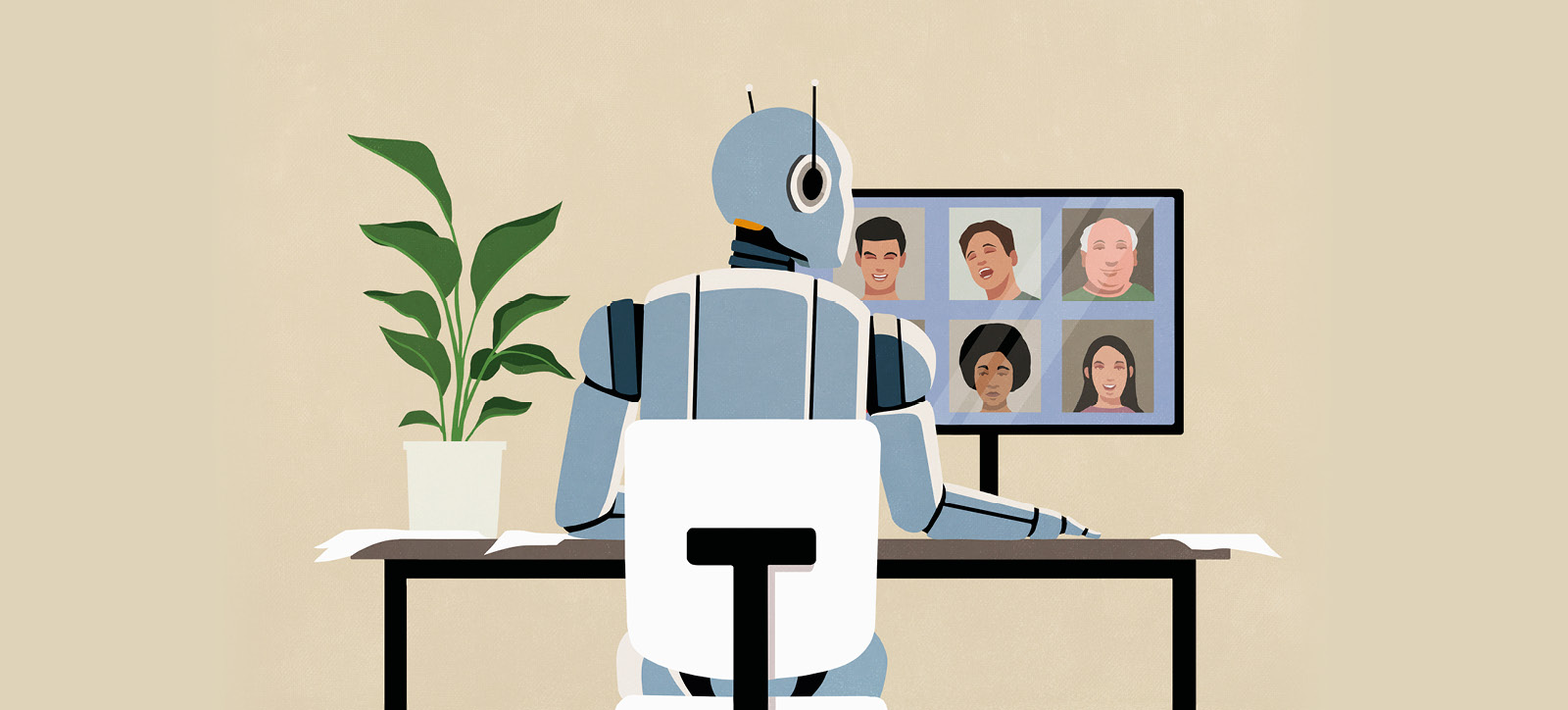
AI-Team: Generative AI could force companies to reconsider their entire approach to teamwork
Teamwork is the cornerstone of many modern organisations. This is hardly surprising. It meets a basic need for social interaction – people enjoy connecting with other people.
Teams also tend to produce better results than individuals. They can tackle more complex problems, pool their expertise, and distribute the workload to improve efficiency.
Credit for their collective endeavours can also be shared in a way that is good for morale. As the old adage goes, “There is no ‘ I’ in team.” But what about AI? Does that have a place in modern teams?
Many organisations have already adopted AI tools in one form or another, even if it's something as simple as reading an AI-generated summary at the top of an internet search page.
Could the next step be cybernetic teams where humans and AI work hand in hand? After all, most Large Language Models (LLMs) – such as ChatGPT, Claude, and Google Gemini – are trained on human language and often act more like a person than a machine.
And if businesses were to treat generative AI as a team member, what impact would that have on performance, collaboration, and innovation?
I set out to explore these questions in my recent research with colleagues from Harvard, Wharton, ESSEC Business School and Proctor and Gamble (P&G).
We conducted a field experiment with 776 professionals at P&G, which owns global brands such as Gillette, Oral B, and Pampers.
The professionals were all new product development experts; some had experience in research and development (engineers and scientists), others were marketing and commercial experts.
Each professional was asked to complete a product innovation challenge. Some worked individually, others in pairs. Some had access to AI, others did not.
Our findings have significant implications for how organisations should structure teamwork in the age of AI.
1 AI boosts performance
Individuals who did not use AI produced the lowest quality proposals. Those working in two-person teams produced higher quality, but took slightly longer to do so.
Crucially, individuals who used AI produced better results than both lone workers and teams who had no access to the technology.
They weren’t just more effective. They were also more efficient, finishing 8-10 minutes faster on average than those working without AI.
Generative AI allowed them to quickly access a wider range of expertise (which they would traditionally seek from human colleagues), interrogate that information, and refine their work.
In fact, it did this so effectively that – for some collaborative tasks – it could act as a substitute for human teammates.
This was underlined by the fact that teams which used AI performed only marginally better on average than individuals who did so.
However, further analysis did highlight an additional benefit to using AI as part of a team.
Many organisations place particular emphasis on ‘exceptional’ outcomes. These are ideas which could generate disproportionately large returns if they were implemented.
Therefore, we ranked the quality of the ideas the workers produced. This revealed that teams using AI were three times more likely to produce solutions that were ranked in the top 10 per cent.
This suggests that businesses seeking ‘breakthrough’ ideas would be well-advised to train their workforce to use AI effectively as part of their teamwork, not just as individuals.
2 AI can break down silos
In many organisations, expertise is confined to silos. This restricts the flow of information between teams and leads to duplicated work, slower decisions, and lower efficiency.
Our findings demonstrate that LLMs can remove these barriers by democratising expertise.
When workers had no access to AI, their ideas tended to reflect their background. R&D professionals suggested more technical solutions; commercial staff focused on their own field of expertise.
Those with little experience of product development performed poorly.
When it came to teams, we found their proposals tended to reflect the professional expertise of the more influential team member.
However, when they had access to AI, both individuals and teams produced more balanced proposals that covered technical and commercial considerations.
This suggests that the technology can help professionals to operate across traditional boundaries and adopt a more holistic approach to solving problems.
3 Human input remains key
Many of the workers in our experiment included large quantities of AI-generated content in their proposals (often in excess of 75 per cent).
This does not necessarily mean that they adopted its suggestions without critically evaluating it. They may have conducted several iterations of prompts – validating the responses using their own expertise and external sources – before incorporating the results into their proposals.
There were also workers who did not incorporate any AI-generated content into their submissions. Instead, they used AI to brainstorm and to refine and validate their own ideas.
Those who relied more heavily on AI produced more similar solutions than those who did not use it.
However, these proposals were still more varied than the results we produced when we asked ChatGPT-4 to solve the same problem iteratively with no human input.
This shows that human input remains vital to the process, as they meaningfully shape and contextualise the suggestions they receive, rather than adopting them wholesale.
4 Gen AI use can prompt positive emotions
A common concern about new technology is its potential to destabilise workplace routines and reduce human interaction, making work less satisfying.
However, we found that professionals who used generative AI reported higher levels of positive emotions such as excitement and enthusiasm, and lower levels of anxiety and frustration.
While AI cannot fully replicate the rich nature of social interaction, our findings suggest that using LLMs may offer some of the same benefits as working alongside human colleagues.
None of this removes the need for business leaders to take care when integrating technologies such as AI. My previous research shows that it is incredibly difficult to identify the limits of generative AI, and therefore to know when to use it, not least because that ‘jagged frontier’ is constantly moving.
However, this study challenges the prevailing view that even when AI outperforms humans on a particular task, overall team performance will decline as trust and coordination are eroded.
Our results show that generative AI is not simply another automated tool, like a calculator or a spreadsheet.
It provides real-time feedback, enhances performance, breaks down silos of professional expertise, and influences how users feel.
This dynamic interaction means that generative AI acts less as a search engine or text generator and more like a ‘cybernetic teammate’.
It can occupy roles we normally associate with human colleagues. And that could force organisations to rethink both their team structures and their entire approach to collaborative work.
- This article is based on the following study: Dell'Acqua, F., Ayoubi, C., Lifshitz, H., Sadun, R., Mollick, E., Mollick, L., Han, Y., Goldman, J., Nair, H., Taub, S., and Lakhani, K. R. (2025). The Cybernetic Teammate: A Field Experiment on Generative AI Reshaping Teamwork and Expertise, Harvard Business School Working Paper, No. 25-043.
Further reading:
Working on the jagged frontier: How companies should use generative AI
Three steps to integrate AI into your organisation
Beyond the hype: What managers need to ask before adopting AI tools
How to evaluate the social impact of your AI strategy
Hila Lifshitz is Professor of Management and teaches Digital Transformation and AI for Business Leaders on the Executive MBA, Executive MBA (London), Global Online MBA, Global Online MBA (London), and Part-time MBA (London Accelerator). She also teaches Artificial Intelligence in Business and Digital Business Services on our Master's programmes.
Learn more about adapting to AI on the School's two-day Executive Education course AI Leadership programme at WBS London at The Shard.
Discover more about AI and The Future of Work. Receive our Core Insights newsletter via email or LinkedIn.
 X
X Facebook
 LinkedIn
 YouTube
 Instagram
 Tiktok