


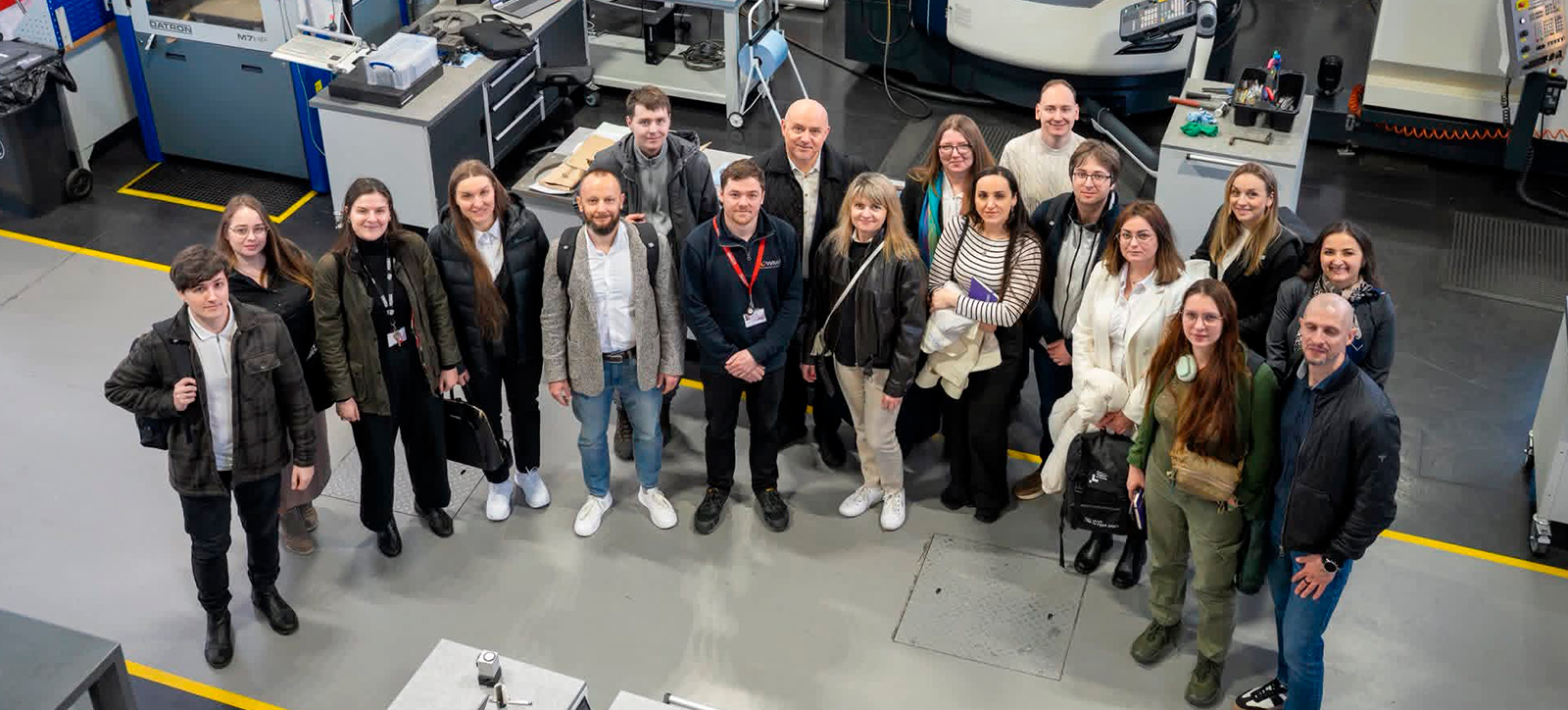
Collaborative learning: Ukrainian STEM academics visit the University of Warwick thanks to a WBS-led initiative
Sixteen of Ukraine's leading scientists and academic figures have concluded an intensive one-week residency at the University of Warwick, transitioning from frontline research to the vanguard of national economic recovery.
This cohort represented the most impactful participants of UK-UA STEM Pro, a first-of-its-kind professional development programme designed to bolster Ukraine's recovery through research, innovation, and industry collaboration.
Led by Bo Kelestyn, Associate Professor at Warwick Business School, the STEM Pro residential equipped Ukraine's brightest minds with the commercial skills and international networks required to drive economic resilience.
Developed at the invitation of the Fund of the President of Ukraine for Education, Science, and Sports, the initiative bridges the gap between scientific excellence and real-world commercial application.
The programme followed a hybrid model, which began with intensive online training for 30 participants before selecting the final 16 for this immersive Warwick residency.
It is a flagship initiative of the President's Fund, a national body established to identify and empower high-achieving youth. With a community of more than 2,000 top-performing young Ukrainians and links to 200 higher education institutions, the fund acts as a primary driver of Ukraine's integration into the global knowledge ecosystem.
In 2026 alone, the Fund's commitment to international co-operation has seen 10 professors from leading UK universities visit Ukraine alongside the delivery of leadership programmes for more than 130 participants. STEM Pro represents a deepening of these ties, an essential pillar of the UK–Ukraine 100-Year Partnership signed between the two countries last year.

The UK-UA STEM Pro programme set a practical, high-stakes goal: by its completion, every participant was required to forge at least one new partnership between a university and a business.
"This isn't just an academic exchange; it's about survival and growth," said Dr Kelestyn, who is from Ukraine and is also the founder of the pioneering Leadership for Educational Transformation programme to support the transformation of education in her homeland.
"Collaborating with Ukrainian academics, learning from each other, and taking Ukraine's cutting-edge research out of the labs and into the real world promises to have a tremendous impact on the country's recovery.
"Warwick is proud to design and deliver this first-of-its-kind programme for STEM academics, helping forge partnerships will strengthen individual careers and the future of Ukrainian academia.”
The residents, spanning disciplines from computer science and bioinformatics to environmental geochemistry, spent their residency embedded within the University's ecosystem, including the School of Science, Engineering and Medicine (SEM) and Warwick Manufacturing Group (WMG). Within the SEM Faculty, they visited research and teaching labs and engaged with colleagues. Beyond campus, the group visited innovation hubs in Coventry, Oxford, and London to observe how UK research is translated into societal impact.
Among the leaders was Roman Nebesnyi, Head of the Research and Development Department at Lviv Polytechnic National University. His team's breakthrough biodegradable hydrogel dressings have been an essential tool since the earliest days of the Russian invasion of Ukraine.
"Our Deep Tech Centre has developed biodegradable bandages from natural materials that can reduce healing time by half," said Dr Nebesnyi about the dressings, which can be infused with painkillers and antiseptics so they do not require frequent changing.
"We have now produced more than 400,000 bandages for hospitals across Ukraine... Being here at Warwick to meet business leaders and observe how scientists collaborate across departments was critical; our goal was to take these best practices back home."
The programme's impact also extends to the human cost of the war. Kseniia Minakova, Professor at the National Technical University Kharkiv Polytechnic Institute, is leveraging her expertise in photovoltaics to support those returning from the front.
"I am here to find collaborations to help our veterans, to learn from colleagues how we can teach them to become leaders and adapt to civilian life after the war," said Professor Minakova. "We are providing veterans with new professions in renewable energy, teaching them to build and monitor solar plants. It is an all-encompassing programme to help them transition."
The architects of reconstruction
The residency formed a cornerstone of the UK–Ukraine Research Bridge, supported by the Foreign, Commonwealth & Development Office (FCDO) and the UK–Ukraine Academic Diaspora Network. It also reinforced Warwick's long-standing "twinning" partnership with Kharkiv National University of Radioelectronics (NURE).
During the programme, participants built an extensive network across leading UK institutions, opening concrete opportunities for joint research, start-up development, and new education and capacity-building initiatives with UK partners.
“Our priority is to ensure that Ukrainian researchers have the tools, networks and opportunities they need to drive innovation. Even in the face of significant challenges, they remain determined to contribute to global science,” said Uliana Avtonomova, a spokesperson for the President's Fund.
“Programmes like this not only support their professional growth and capacity-building, but also demonstrate the importance of international solidarity by connecting their expertise to a wider research community.”
As the residency concluded, participants entered the next phase of the programme, shifting focus from immediate skill-building to the long-term development of the partnerships they have forged.
For leaders like Dr Nebesnyi and Professor Minakova, the tools and strategies gained at Warwick served a vital purpose: ensuring that when the peace is won, the scientific foundations of a modern Ukraine are already in place.
 X
X Facebook
 LinkedIn
 YouTube
 Instagram
 Tiktok