
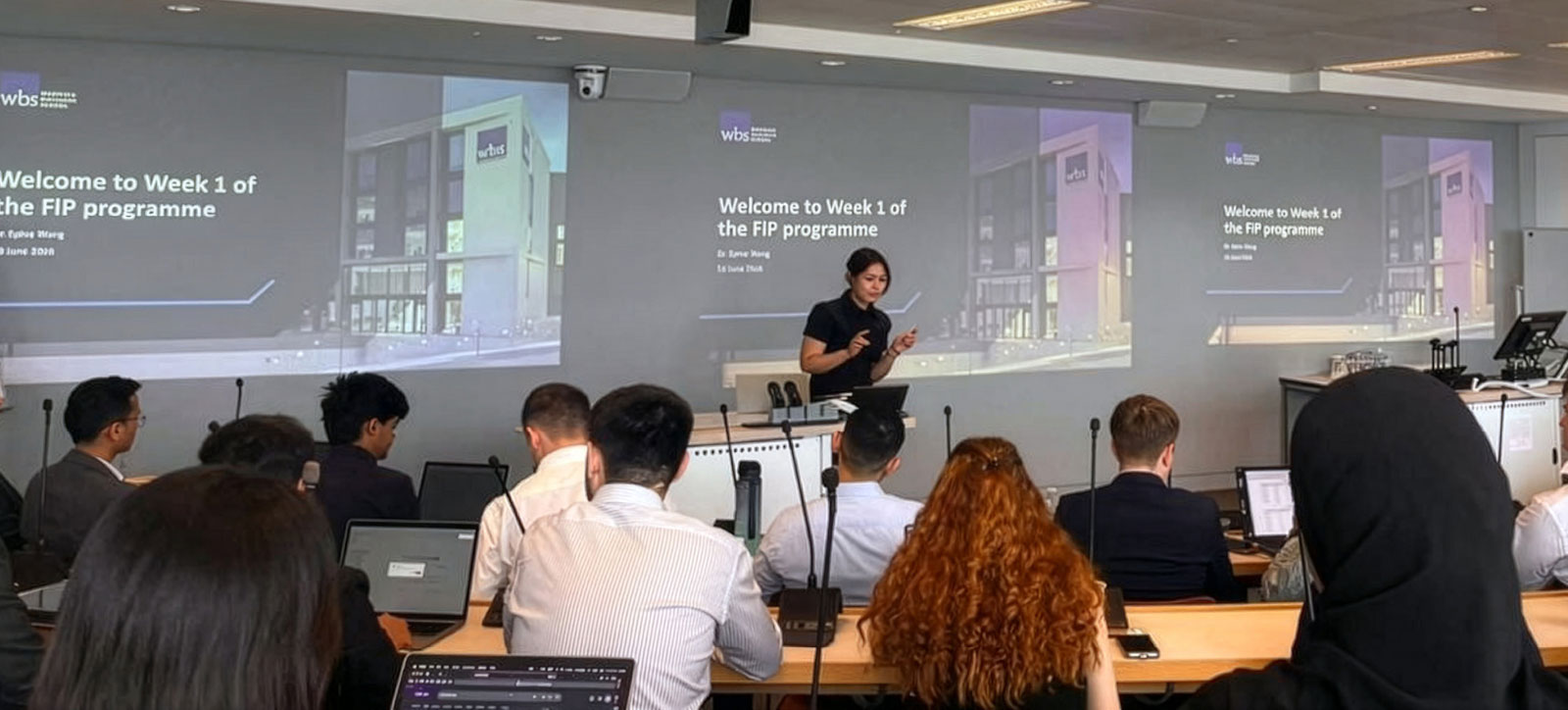
FinTech in Practice: Module leader Ephie Wang introduces the first series of presentations at The Shard
Somewhere in the old neighbourhoods of downtown Tokyo or Seoul there is a real-estate investment opportunity waiting to be discovered, and this summer a group of MSc Financial Technology students at Warwick Business School will see it as their job to find it.
This task is just one of a number of the knotty, real-world challenges that sit at the centre of a pioneering module in the inaugural year of the Master’s programme.
Held not in lecture halls but at WBS London at The Shard, within sight of London’s financial district, the FinTech in Practice module marks a deliberate shift away from traditional academic end-points such as dissertations or internships.
Instead, 64 out of a cohort of 87 MSc Financial Technology students have opted for the alternative capstone: two months this summer of industry-led problem solving, followed by a final presentation back to the companies that set the briefs.
“It’s all about commerciality,” said Dan Philps, Head of Rothko Investment Strategies and Honorary Research Fellow at the Gillmore Centre for Financial Technology at WBS, who set up one of the projects for the students.
“I’ve always considered WBS as a firehose of brainpower ready to be tapped commercially so from our perspective, the industry perspective, it’s brilliant because we get to work with the students.
“And it is valuable for the students because we are pushing blue sky projects which are right at the cutting edge.”
Turning complexity into value
The spotlights on Tokyo and Seoul, meanwhile, were part of the task set by Richard Spencer, Advisory Director at Goldman Sachs Asset Management, to identify a promising residential investment at street level in one of Asia-Pacific’s most complex urban markets.
Set on the first day of the FinTech in Practice module in June, the project was asking students to build what it calls an ‘agentic discovery layer’ – an AI-driven framework capable of sourcing, harmonising and analysing disparate data across cities.
The aim was to move from city-level intelligence down to specific submarkets and ultimately individual streets, using a combination of AI agents: one to discover relevant datasets, another to standardise them, and a third to generate synthetic insights such as comparable ‘scorecards’ across locations.
For Mr Spencer, who is also an Advisory Board Member for the MSc Financial Technology, the exercise reflects a broader shift within the investment industry, which particularly in property often deals with opaque, unstructured data.
“Real estate investment is all about turning complexity into value,” he said.
“But we’re often acting on imperfect information. The challenge is to organise fragmented, localised data into actionable intelligence.”
AI tools that synthesise real estate intelligence can generate leads but must be treated with caution, he added.
“These systems don’t provide the final answer,” he said. “They prompt faster thinking but you still need human judgement.”
There are 19 industry partners involved in the module, spanning global banks, fintech start-ups and specialist investment firms. Each has presented a fintech challenge to the WBS students based on current market conditions.
NatWest, for example, is asking whether autonomous AI systems could accelerate the arrival of ‘open finance’ – an ecosystem in which data flows freely across platforms and institutions. Students were tasked to assess not only the technological potential but also the associated risks.
Meanwhile, Acquired, a payments processor, is looking at how to improve transaction routing models – the behind-the-scenes engines that determine how payments are processed to maximise approval rates and minimise costs.
In another corner of the programme, Certonymity – an identity and payments start-up specialising in advanced cryptography – frames the challenge in more philosophical terms. “Fintech is about trust,” said its representative, Christopher Williamson, who advocates the term TrustTech.
The company is building a hybrid identity and payments network designed to reconcile competing demands for privacy, security and regulatory compliance.
Students are being asked to tackle a key friction point: avoiding the duplication of slow and privacy-invading steps such as ‘know your customer’ checks across financial services, so as to better balance usability against legal and technical constraints.
Learning by doing
For the WBS faculty, FinTech in Practice is an attempt to close the gap between theory and practice in a field evolving at breakneck speed.
“We wanted to do something different,” said Ephie Wang, Teaching Fellow and Module Leader. “This is not simulated data or case studies from 10 years ago. This is what’s happening now.”
Students on the module are required to select one of the industry projects and work individually on a formal business report, before regrouping into teams to present their findings. The structure deliberately blends competition with collaboration, mirroring the pressures of professional environments.
“The emphasis is as much on communication and critical thinking as on technical expertise,” said Dr Wang. “The students’ reports must articulate not only a proposed solution but also why the problem matters, what existing approaches miss, and why their new idea is a feasible alternative. They need to tell a good story.”
For the students embarking on the module in June it was initially about interacting with actual businesses and real-world challenges. As they began to hear the company presentations, some were being drawn to the cryptography project, and others to real estate investing, payments infrastructure or quantitative investing.
For Moun Benyettou, who studied English as an undergraduate, the opportunity to make contact with London’s business community at The Shard, was transformative. “I can now truly call myself a Finance Bro!” he said.
“We all felt like we are one step closer and, indeed, one step away from the professional environment that we're aspiring to join.”
The students will be back in September to present their project findings. The likelihood of any student identifying that investible street in Tokyo or Seoul is probably slim. But that was never the point.
In the process of searching for it, WBS students are learning how the future of finance will be built.
If you are an organisation interested in taking part in the FinTech in Practice module in the future, please contact our CareersPlus & Employer Relations team.
 X
X Facebook
 LinkedIn
 YouTube
 Instagram
 Tiktok