
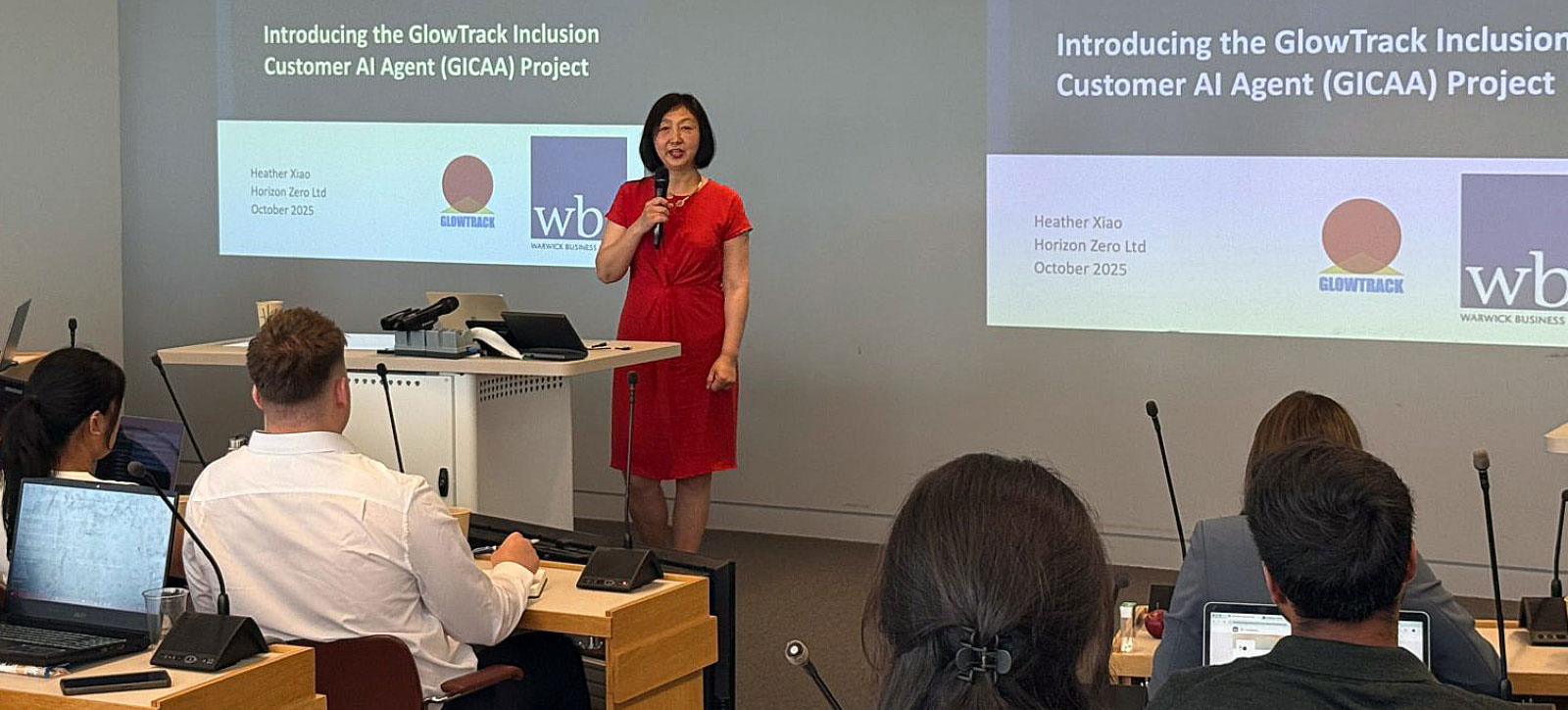
Engagement: Heather Xiao, of Horizon Zero, sets out a challenge for MSc Financial Technology students
Being in the room where it all happens is the key strength of a pioneering Master’s module at Warwick Business School, according to the students who are taking it.
Candidates on the MSc Financial Technology networked with major industry players for six days this June as part of their FinTech in Practice module, a capstone programme designed to replace the traditional dissertation or internship with real-world problem solving.
Hosted at WBS London at The Shard, the initiative has brought together students and executives from some of the financial sector’s biggest names, including NatWest and investment bank Peel Hunt, together with a range of fintech outfits such as Umushroom, SDK.finance and Cardamon.ai. The 64 students will now spend the summer developing solutions to the live business challenges that 19 companies have set them as part of the module, and will present back in September.
“Being in the room with it. That’s why I’m here,” said Anastasija Gore, a former mortgage broker who joined the MSc programme after studying a degree in finance. “A lot of courses nowadays come from a perspective of textbook and academic learning. Here, we’re actually in the room with it.”
Yuwei Zhou, who previously studied a degree in trade economics in China, said the chance to interact directly with industry professionals was unlike anything she had encountered elsewhere.
“You are in the same place, in the same elevator, with those who are deep in this industry,” she said. “The School provides such a good opportunity to connect with them.”
Emerging technologies
One of the company challenges was one set by NatWest, which is asking the Master’s candidates to examine whether agentic AI could become the catalyst for the scaling up of ‘open finance’ – an ecosystem in which data flows freely across platforms and institutions.
Amelia Stewart, Payments Strategy Lead at NatWest, said: “We’re here to see if they’d be interested in joining an industry project with us to look into how open finance and agentic AI might intersect and what implications that might have for financial services.
“The students have been brilliant. We received so many questions and so much engagement.
“There’s definitely a quality there too – students with the boldness and curiosity to ask those questions in the room that no-one else has thought of. Those are the questions that spark real debate.”
Ms Stewart, whose role involves assessing payment innovations ranging from generative AI to digital assets, said one of the great advantages students offered was a fresh perspective.
“You innovate these things in boardrooms and conferences over and over again, but actually bringing people in who haven’t worked in banking for 20 years and getting their perspective as consumers and early adopters of the technology is invaluable,” she said.
Employability of WBS students
With student employability being a key priority for Warwick Business School, this direct engagement with industry is particularly important. “This module gives WBS students the opportunity to work on real industry challenges and gain first-hand insight from leading organisations across the fintech sector,” said Ranj Johal, Relationship Manager with WBS CareersPlus & Employer Relations.
“We are grateful to our industry partners for their support and for helping to bring the industry into the classroom.”
Moris Strub, Associate Professor and Course Director, said: “There will be only three or four students working on each project with an industry partner but the companies will also be networking with the students and watching their presentations in September.
“So, they may well spot a person with a key skill or aptitude they are looking for. They may well find a good match for a particular role.”
For their part, the students have been able to explore their interests as new technologies bring disruption to the field of financial services. Given her background as a mortgage broker, Anastasija was interested initially in the company presentations that looked at regulatory standards and systems and how they can be implemented amid fast-moving technological developments. Yuwei, meanwhile, was interested in a project that covered quantitative investing.
Fellow candidate Moun Benyettou, whose first degree was in English, said the interdisciplinary nature of the industry presentations had helped students from a wide range of educational backgrounds engage with complex topics ranging from AI-powered investing to cryptography and payment systems.
“Our students have come from all sorts of backgrounds, but that mirrors the field they are going into,” Dr Strub said. “Financial technology is interdisciplinary.
“We want to educate people who have a broad vision and are able to work across disciplines because that is exactly what they will encounter in their career afterwards.”
MSc candidate Nafisah Bashir, for one, was enjoying the range of possibilities introduced at The Shard. “I am very interested in the issues of privacy and digital identity posed by blockchain technology, but I’m keeping an open mind,” she said.
As with her fellow candidates, though, it was the opportunity to build networks with leading practitioners at a formative stage in their fintech career that mattered the most.
The graduate in economics, finance and banking described the experience of meeting Heather Xiao, CEO of smart data research and consulting firm Horizon Zero, as “inspiring”.
“Listening to a woman talk about her fintech career and the leap of faith she took was really encouraging,” she said.
“That’s what I really like about this module. I’m in the room where it happens.”
If you are an organisation interested in taking part in the FinTech in Practice module in the future, or wish to engage with Warwick Business School students, please contact our CareersPlus & Employer Relations team.
 X
X Facebook
 LinkedIn
 YouTube
 Instagram
 Tiktok