From lockdown startup to multi-million pound brand: WBS alum Shreya Mittal on building CAVA
WBS alum Shreya Mittal on founding a business mid-lockdown, what she learned from WBS, and what's next for her brand CAVA.


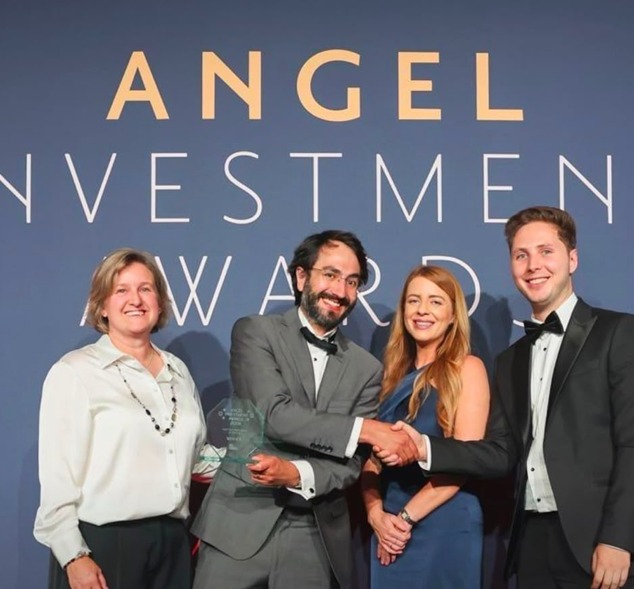
Harrison Faull is co-founder of Aligned Syndicate, an angel investment syndicate backing early-stage UK startups. The syndicate was recently named best deep tech investor of 2026 by the UK Business Angels Association (UKBAA), the industry body for angel investors.
Since launching, Aligned Syndicate has made 24 investments into UK startups and deployed £3m. Harrison now invests full time. We spoke to him about the award, how he decides which founders to back, and his advice for current students.
Aligned Syndicate was recently recognised as the best deep tech investor of 2026 by the UKBAA, what does that achievement mean to you?
“It came as quite a surprise as we were picked ahead of investors that make an order of magnitude more investments than we do. Our thesis is very selective. We try to make 10 of the highest quality investments possible a year, so the award says something about our selection process.
“It also matters because of my age. I’m 27 and the UKBAA is the industry body for angel investors. Validation from that room carries weight with prospective investors, more than anything I could say about myself.”
Can you tell us a bit about your background and what made you choose WBS?
“I chose Warwick because of the students that I met on an open day. They were just as entrepreneurial and ambitious as I was. I knew surrounding myself with that calibre of person would increase my chances of being successful.
“Before Warwick I was raised in Bournemouth on the South Coast of England and enjoyed my summers on the sea. I like to think that I had one of the coolest summer jobs: selling ice creams from an ice cream boat.”
Your path has led you from studying Management to founding a startup investment syndicate, can you walk us through how your career evolved to get there?
“I happen to have made one of my best angel investments while still at Warwick. The founder went on to Dragons' Den and got an offer from every dragon. Both Meta and Google are clients and on paper it is currently the biggest gain of any investment I have made. The business has pivoted a few times and now sells alternative data (of 500k consumers) to hedge funds.
“I founded Aligned Syndicate to formalise what I was already doing informally. Word had spread that I had made some good investments, and other angels wanted in on my future deals, leveraging the diligence work I had already. One thing led to the next and now I have the extremely fortunate job to invest full time.”
Can you tell us more about your role at Aligned Syndicate as Co-Founder and MD?
“Most of my week is spent saying no. For context, we invest into less than 1% of the founders that we screen. It’s really tough to raise venture capital as the bar keeps rising each year. With the rise of AI, investors expect more than ever from small founding teams.
“The broadest test I can apply to anything is whether there is a viable path to 25x our capital in 7-10 years. Most businesses are not built to scale so rapidly, so that one question does a lot of filtering for us.
“Then I ask probably the toughest question: whether the business will still be defensible in seven years. This is really important to us, as the exit is the only moment our angels actually make money. And it’s one of our strongest USPs, as we only charge investors once they’ve sold their shares for a profit. Ensuring that we are fully aligned with their outcome.
“On top of that, my co-founder and I invest £200k annually into startups alongside our investors, so we have real skin in the game.
“My other customers are investors, who often arrive with misconceptions about angel investing. I probably turn away one in three prospective investors as this is not the right asset class for everyone. Ideally, you need to write at least 15 cheques to have a chance of catching an outlier. Our minimum ticket is £10k and our members typically back three deals a year. We’ve grown organically and our members include exited founders behind a $1bn healthcare exit, a £200m marketing exit and a £100m fintech exit, alongside early Revolut employees and MDs at Goldman Sachs.”
Looking back at your Management degree, are there any specific skills or areas of knowledge that have proven particularly valuable when it comes to running your business?
“The financial modelling course was the most useful thing I took at WBS, along with lectures from Peter Corvi. I use that knowledge every week, reading cap tables and stress testing founder models. A surprising number of founders aren’t financially literate. Finding these problems early gives me a chance to suggest a solution before the startup blows up.
“Some of the strategy courses are also useful day to day. Particularly the habit of asking what makes a business defensible. Almost every company we reject fails that question. AI and agentic code will continue to rapidly move the goalposts here. The best investors are now hunting for IP rich businesses that the next LLM model cannot swallow. Y Combinator, the best startup accelerator in the world, has never funded more hardware startups than it does today. I think that’s a direct consequence of software being commoditised.”
What are some of your most memorable experiences or highlights from your time at WBS?
“The people. Recently five of us flew to Peru and visited Machu Pichu together, six years after graduating."
With 24 investments under your belt and growing, where do you see Aligned Syndicate heading next?
“I’d like to scale Aligned to the point where we take our full allocation in every startup we shortlist. So more angels, not more deals.
“A lot of my peers are chasing larger and larger funds. Bigger funds result in significantly less risk for the LP and more stability. They also mean you outgrow early-stage opportunities and start writing cheques into established companies. I find that less fun. There is less room to generate alpha. People build models to underwrite the growth story, and nine times out of 10 the deal goes to whoever is willing to pay the most on the day.
“That is less true at pre-seed with technical founders needing help with fundraising, customer introductions and crafting business models. I like that part. The zero to one stage is where I can be useful.
“On a personal level, I want to play a small part in helping us take more pride in our startup ecosystem. The UK took 40% of all European venture funding in the first half of 2026, more than Germany and France combined! We punch far above our weight, and I don’t think it’s spoken about enough.”
What advice would you give to current students?
“Stop getting in your own way. Most students I speak to talk themselves out of opportunities.
“In my final year I sent more than 60 applications to VC funds. Each one named the three startups I thought that fund should back, with the logic and the data behind the picks. COVID arrived and most funds froze hiring, so the timing was terrible. But the process made me better and kick started my network in the VC world.
“You are not a robot. You’re one of the best graduates in the country. Find a way to tilt the odds in your favour. If that means bending the rules, so be it. You are in a fortunate position where there is nothing to lose!
“Give yourself the chance.”
WBS alum Shreya Mittal on founding a business mid-lockdown, what she learned from WBS, and what's next for her brand CAVA.
The BSc Business & Management at Warwick Business School helped to set Luis Servet on his path to global fashion house.
Sponsorship from firms such as L'Oreal and DPD enables Treeapp users to plant a tree for free by watching adverts on their phone.
 X
 Facebook
 LinkedIn
 YouTube
 Instagram
 Tiktok