From lockdown startup to multi-million pound brand: WBS alum Shreya Mittal on building CAVA
WBS alum Shreya Mittal on founding a business mid-lockdown, what she learned from WBS, and what's next for her brand CAVA.



Undergraduate alumni, Duncan MacDonald, shares his placement year experience and how he sparked an mental health initiative that continued into his final year at WBS.
In May 2025, halfway through my placement year at Porsche Cars GB, I stood in front of the entire company and spoke openly about personal loss, mental health, and why creating space for honest conversations can change everything.
Nothing about that moment was in my plan when I walked in as a placement intern nine months earlier. Nothing about the £4,000 Ironman 70.3 fundraiser for children’s mental health, or the Tuesday-night running community I would launch in my final year at Warwick, or the 200 members it would grow to before its last run of the year. And at that point, no certainty about the First Class Honours I have just graduated with from Warwick Business School.
The lesson those two years taught me is one I think every business student should hear: you do not need a title, a budget or seniority to start something that matters. You need conviction, patience, and the willingness to do the work no one is asking you to do.
This is the story of how a self-initiated mental health initiative called Driven to Care, pitched from the intern seat, became embedded into the culture of a global brand, and how it followed me home to Warwick to set up a running community.
I have not always spoken openly about why this work matters to me, but the honest answer is that two experiences shaped it. The first was being diagnosed with Type 1 Diabetes as a child, a condition that taught me, at a very young age, that physical and mental health are not separate systems. The second was losing a family friend to suicide in 2021. Mental health stopped being a subject I cared about and became something I refused to walk past. That was the conviction I carried into Porsche Cars Great Britain.
My job at Porsche was as a Retail Marketing Communications Intern; supporting national campaign delivery, dealer-network communications, brand activations and customer-facing marketing across the Porsche Centre network. It was fast-paced, high-standard and exactly the placement year experience I had hoped for.
But alongside it, I was quietly building something else. For three to four months, almost entirely in my own time, I researched, drafted and refined a proposal for a company-wide mental health initiative, long before approaching a single senior stakeholder.
The idea did not arrive fully formed. It came partly from my own intuition: the sense, walking around the business, that mental health support existed but could be brought further to the forefront internally, and that culture was where the real work needed to happen. But it also came from listening. As I spoke with colleagues across the business, I learned what sustained pressure actually cost people, including one who had suffered a stress-related stroke. Those conversations turned the case from a hunch into a responsibility.
When I finally presented it to our Marketing Director, he gave me a piece of feedback that has shaped my thinking ever since: "The standard we walk past is the standard we set." He also gave me clear direction: before we said anything externally, we had to earn the right to internally. So that is where we focused.
Over the following months I worked across HR, PR, Facilities and Marketing Communications to build real infrastructure inside the business: peer support initiatives, Mental Health Champion roles beyond HR, Mental Health on the Menu, and human performance coaches from Silverstone speaking on the mind and body connection.
The turning point came in Mental Health Awareness Week, when I stood up in front of the company. No senior authority behind me, just months of preparation and the belief that saying something was worth the discomfort of staying quiet.
I spoke about the silent strugglers, the colleagues running "emotional Ironmans every day, quietly, invisibly", and closed with the line that still anchors my thinking: "driving performance isn't just about machines. It's about humans. And humans need care."
A few weeks later, I crossed the Ironman 70.3 finish line in Bolton, raising over £4,000 for Porsche’s charity partner Place2Be. The work was recognised through awards by Porsche GB's CEO and Marketing Director, but what mattered more were the colleagues who reached out privately afterwards to share their own stories.
The biggest lesson: vulnerability is not weakness. It is what real leadership looks like at every level, including the most junior.
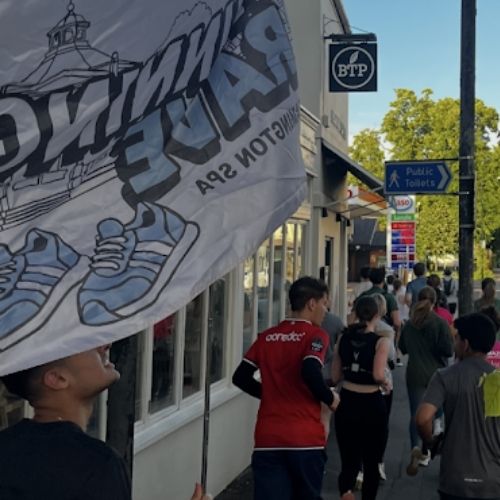
Returning to Warwick for my final year, I could not leave the work behind. Loneliness, isolation and lost routine are often the precursors to more serious mental health challenges, particularly through long winters and students need somewhere reliable to belong before they reach crisis point, not after.
That is the idea behind The Running Rave: a student-founded, independent community combining a 5km run at a conversational pace, music through portable speakers and a social at a local pub afterwards. The point is not the run or the pint. It is the low-pressure space to meet people and build genuine connection. We met weekly on Tuesday evenings in Leamington Spa.
What began with two of us testing speakers strapped to our backpacks in week one of Term 1 grew into something none of us saw coming.
By the end of Term 1, we had grown to nearly 90 members. Term 2 brought sleet, snow, frozen hands, a party for over 120 people, and turnouts of over 30 runners a week. Term 3 became our best yet. Our biggest run of the year exceeded 50 members, pub gardens were packed after every finish, and a summer series ended with a barbecue. We hit 200 members in the days before our final run of the year. Along the way, we received sponsorship from Warwick Business School, notably Mark Johnson’s Associate Dean fund, to support student mental health, and most importantly, we never once cancelled a run. Every Tuesday, without fail, from Term 1 through Term 3.
The numbers matter, but what stays with me are the messages. Members have told me directly that the club helped them through seasonal depression, low mood and isolation, and that for many, it became the weekly anchor they relied on through the hardest winter months. One wrote: "Knowing the run club would be on every Tuesday night no matter the weather gave me something to look forward to each week." Another joined not considering themselves a runner at all, and later completed their first half marathon.
One outcome I had not anticipated, but am particularly proud of, is what it has offered our female members. Running in a large, well-lit, audible group has given them a way to safely exercise outdoors after dark, including helping a victim of sexual assault to exercise safely with us in a supportive group setting.
Whether you are an intern inside a global brand or a student with a speaker, the fundamentals are identical: listen, build the case patiently and make the standard you want to see visible. Most of the work happens before anyone notices, but consistency compounds, and culture is built one conversation at a time.
Two years ago, I did not know any of this. I was a student with an idea I was not sure I had the right to pitch. If there is one thing I would say to anyone reading this from a junior seat, whether in a business, a lecture theatre, or anywhere else, it is this: You do not need a title to lead. You just need to refuse to walk past.
WBS alum Shreya Mittal on founding a business mid-lockdown, what she learned from WBS, and what's next for her brand CAVA.
Undergraduate Ambassadors share the one piece of advice that has made the biggest difference to their own wellbeing.
 X
X Facebook
 LinkedIn
 YouTube
 Instagram
 Tiktok