


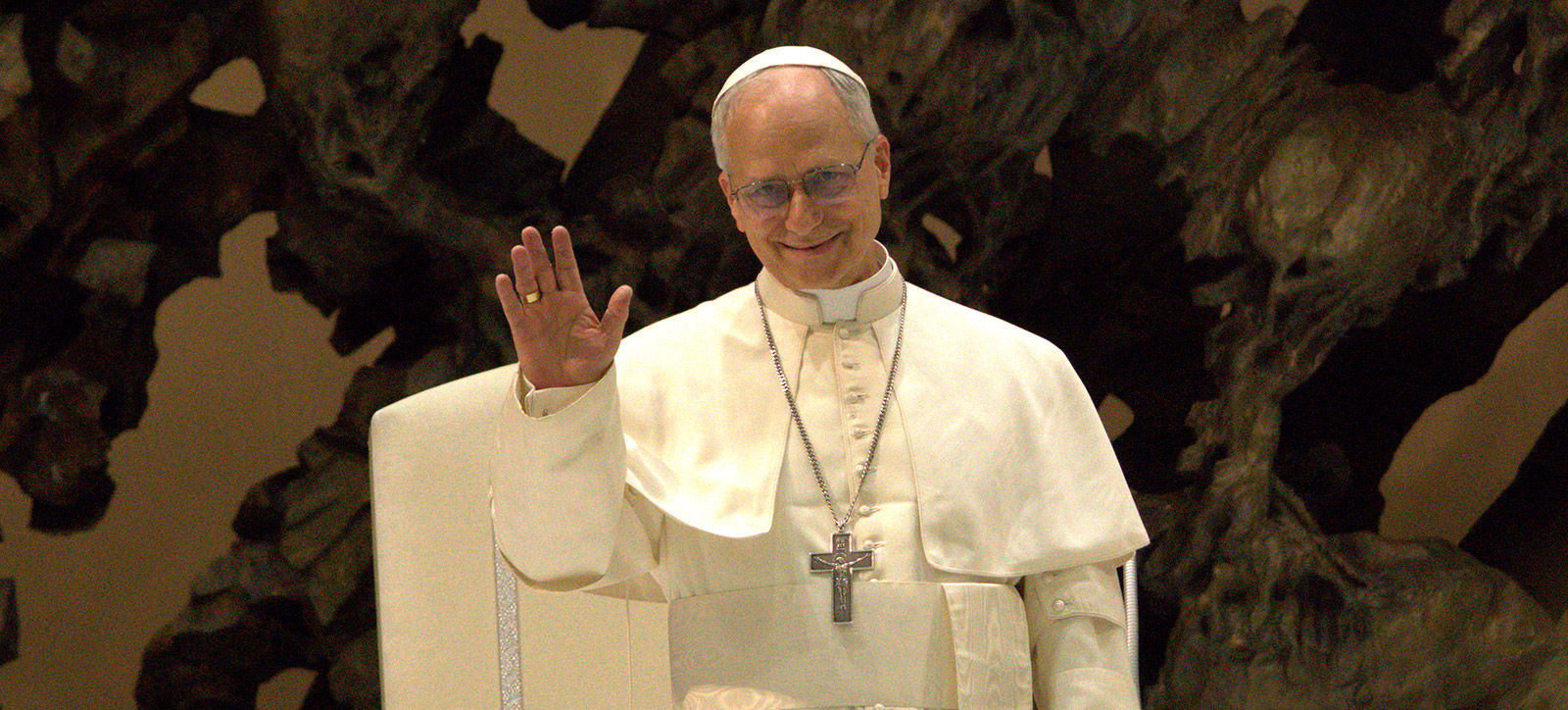
Unifying force: Pope Leo has used 'strategic ambiguity' to lead such a complex organisation like the Roman Catholic Church (Image: Edgar Beltrán, The Pillar)
On the first anniversary of Pope Leo XIV being anointed the head of the Roman Catholic Church, it is perhaps a good time to reflect on his leadership style and how when leading large complex organisations 'unified divergence' has become a central concept.
And especially as Robert Francis Prevost, the first American pope, has demonstrated that the advice regularly bandied around for leaders to aim for 'consistency' is hugely overrated.
The standard story tells leaders to be clear, stable and recognisable: develop a style, be authentic, be consistent. That logic may work in relatively stable environments, but it starts to break down in systems shaped by centuries of history, strong identities and entrenched power - exactly the kind of system Pope Leo was elected to lead by the College of Cardinals after replacing Pope Francis a year ago.
In these environments, change does not fail because leaders lack clarity. It fails because it disrupts deeply held meanings, relationships and equilibria.
In his first year since being inaugurated at St Peter Basilica in the Vatican City, Pope Leo has not offered a single, easily pinned‑down style. Instead, he has led with a deliberate range.
At times he appears pastoral, especially on his frequent trips to Latin America, where he has emphasised listening and closeness to those on the margins of the Church and society. At others, he is institutionally cautious; working within existing structures, respecting canonical processes and signalling continuity rather than rupture. In key moments, he can be direct and firm, particularly when dealing with internal resistance or questions of accountability and governance, such as the recent spat with US President Donald Trump.
But just as striking is his willingness to be deliberately ambiguous. The Pope often asks questions without immediately resolving them. He signals shifts symbolically - through who he meets, what he highlights, which appointments he makes and the topics he puts on the agenda - before translating those shifts into formal decisions. He also allows different constituencies within the Church to live with a degree of interpretive freedom about where reform is heading, keeping them engaged even when they might disagree.
This is not inconsistency. It is strategic ambiguity.
In my recent work on systems leadership, I describe a pattern called 'unified divergence': systems that achieve alignment of action while preserving diversity of interpretation.
Collective leadership emerges when people move in the same direction, but not always for the same reasons. Strategic ambiguity is one of the mechanisms that makes this possible. It leaves enough space for different groups to see their own convictions reflected in the overall trajectory, without fragmenting the common path.
Pope Leo's leadership so far can be read through this lens. His pastoral gestures resonate with those who prioritise inclusion and social justice, while his institutional caution reassures those anxious about continuity and doctrine. And then his decisive moments speak to those who want clear accountability and firm moral guidance.
Different parts of the Church emphasise different aspects of his leadership, but they remain connected to a shared centre of gravity. That is unified divergence in practice.
This is where many mainstream leadership models show their limits. They privilege coherence and predictability. But at a systems level -especially in a global Church - predictability can become a liability.
In legacy institutions like the Catholic Church too much clarity, too early, can harden opposition, while too much consistency makes leaders easier to anticipate and resist. And too much directness can trigger defensive coalitions and polarisation.
What becomes critical instead is 'range'. This is the ability to shift how you show up without losing direction and the capacity to steward unified divergence rather than enforce uniformity.
High profile leadership in the modern world
Strategic ambiguity is crucial here. It allows leaders like Pope Leo to signal intent without prematurely closing down interpretation, and it helps build coalitions across groups that do not fully agree.
Used well, this is not vagueness; it is disciplined incompleteness, ie saying enough to orient the system, but not so much that every line is immediately weaponised.
So perhaps the core leadership question for figures like the Pope shifts from: 'what is my leadership style?' to: 'what range can I credibly deploy and how do I cultivate unified divergence in the system I am leading?'
Because in complex, legacy systems consistency can limit your options, clarity can backfire if mistimed, and control is often more illusion than reality.
Leadership, at this level, is not a fixed identity. It is a calibrated, relational response to a resistant, meaning‑making system; one that, as the emerging pattern of unified divergence suggests, must be led collectively rather than through a single, dominant voice.
Dimitrios Spyridonidis is Professor of Leadership and Innovation. He teaches LeadershipPlus on the Full-time MBA, as well as Leadership and Strategic Leadership Development across the Executive MBA, Executive MBA (London), Accelerator MBA (London), Global Online MBA, and Global Online MBA (London).
Learn more about leadership on the WBS Executive Leadership programme.
Discover more about Leadership. Receive our Core Insights newsletter via email or LinkedIn.
 X
X Facebook
 LinkedIn
 YouTube
 Instagram
 Tiktok