

Culture club: Managers struggle to include culture in strategic decisions, but a simple blueprint can help
“Culture eats strategy for breakfast.” We’ve all heard this quote, which is often (incorrectly) attributed to the visionary management consultant Peter Drucker.
Yet managers struggle to weave culture into the decision-making process. This is not surprising.
Culture is difficult to measure and the measures we do have often don’t work. They are simply too generic. Few executives are comfortable making decisions which are not rooted in data and fact.
Working for three years within a large asset management company – which has more than 10,000 employees and $750 billion of assets under management – we developed a blueprint that can easily be replicated elsewhere. It’s a four-step process combining an adaptable survey and workshops.
1 Define what ‘good’ looks like
Let’s assume that you already have a set of core values (if you don’t, you had best get started on developing those). For the firm that we worked with, these values include ‘bold’, ‘curious’, and ‘compassionate’.
To build your own assessment tool, begin with these values.
The company initially asked an external consulting firm to create a GLOBAL framework for subsidiaries to support their annual employee performance review.
That turned out to be a misstep; the executives actually wanted a more organic tool that worked on the local level.
However, they were unable to secure the buy-in of their Japanese subsidiary.
It turns out that the specific words used to define your values can be highly context sensitive, and their precise meaning can vary across different countries and cultures. This may seem obvious, but it is easy to overlook when optimising at a global level.
In this particular example, the word ‘bold’ did not land as desired in Japan. Terms like ‘proactive’ and ‘urgency’ worked far better for this particular audience.
It did not take long to realise that we would only be able to create a solid assessment tool for the company’s culture by consulting the different stakeholders in each subsidiary.
Based on this insight we broke down the values into smaller, more translatable constructs.
We were also able to define what good practice would actually look like for different locations, considering national nuances.
Remember, clarity drives accountability. These statements should not be empty slogans. They should clearly define positive behaviours.
Here are the definitions we produced for our company’s Ireland subsidiary which show that, even in English-speaking countries, cultural translation is necessary.
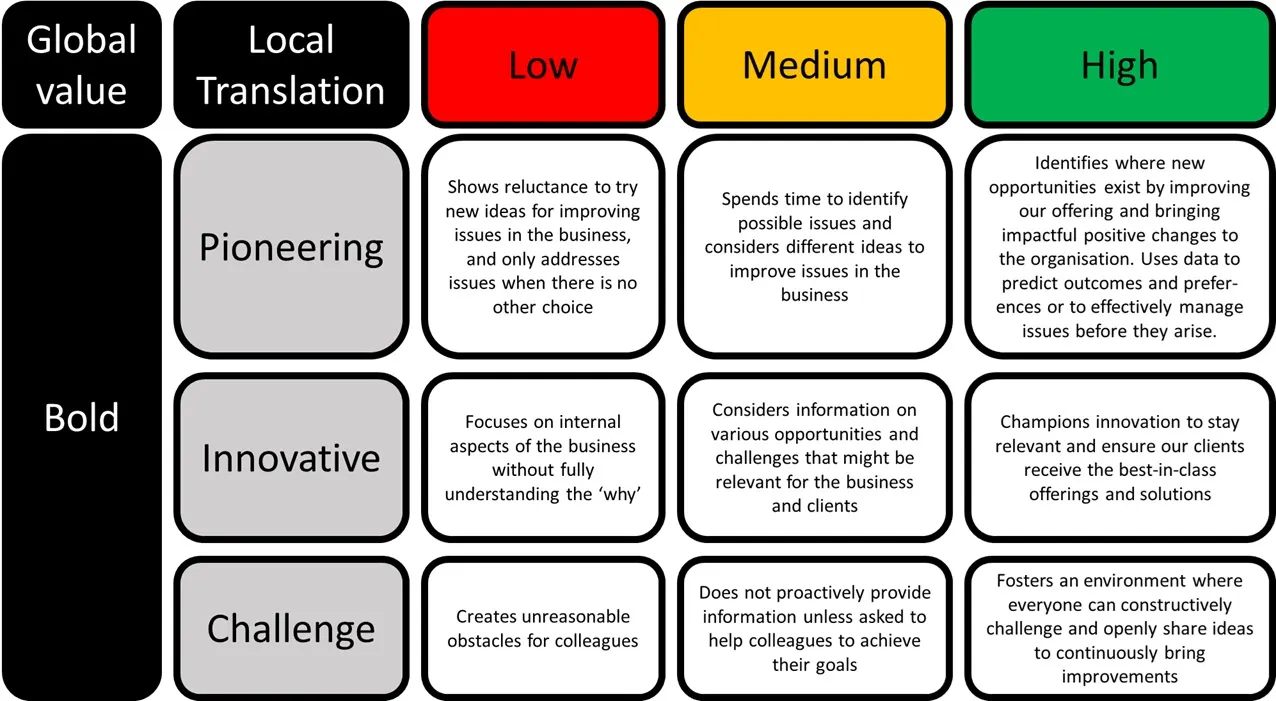
It’s not rocket science. As soon as we started to engage with stakeholders, we understood the need to translate global values in a way that made sense locally.
The main challenge was the time it took to get this right. However, it was time well spent. Not doing this sets you up for failure before you’ve even started.
2 Survey staff effectively
Once you have developed an understanding of what good cultural practices look like, in regards to your values, you can then design the pertinent survey items.
For our company survey in Ireland, we asked employees whether they agreed with a number of statements about how the company embodied its ‘bold’ value.
These included: “My company is quick to adapt to fundamental shifts in the industry” and “People are completely transparent about the business’s performance, even when the story is not positive, to ensure prompt corrective decisions”.
The survey also featured three open-ended questions, generating 3,000 qualitative comments that provided vital context for our analysis. Fortunately, leveraging modern AI tools makes processing this substantial volume of text highly efficient.
Securing buy-in from business unit managers prior to launching the survey was a critical step. This proactive alignment eased the implementation of necessary operational changes driven by the results.
To maximise engagement, QR codes linking directly to the survey were placed on posters across high-footfall communal areas, such as the cafeteria and lifts. This approach helped to secure an average response rate of 70 per cent, establishing a statistically robust dataset that compelled management to act decisively on the findings.
3 Workshop and evaluate the results
While it is common and tempting to share only the headline results post-survey, we took the additional step of translating this raw data into actionable strategic insights. To build momentum, we facilitated a series of collaborative group assessment workshops.
The workshops were focused on collectively assigning a maturity rating for each of the company’s values and translated behaviours in each location.
Armed with a solid understanding of the data, the workshop participants were grouped into cross-functional cohorts to discuss the survey output and key insights.
The breakout sessions centred on an honest appraisal of our culture: where did we live our values, where did we have gaps? And how does it affect our business?
To complement these findings, we integrated data from customer satisfaction surveys, the company's complaints log, and HR data. This triangulation of data enriched our understanding and validated the core insights derived from the internal survey.
This mixed methods approach ensured a more accurate evaluation of the organisational culture of the company.
4 Identify what needs to be done
Using this feedback, regional leadership identified localised strategic priorities and established tailored country-specific management action plans (MAPs). It is vital that senior leaders monitor progress and maintain accountability moving forward.
This approach, combining value-based metrics with workshops bringing the decision makers to the table for an open cross-functional discussion, turned culture from an abstract concept into a measurable, manageable asset.
Following this four-step framework empowers executives to measure the strength of their organisational culture and optimise their performance.
Ultimately, true cultural transformation is achieved by engaging your staff and aligning them along the strategic vision, because sustaining momentum requires a collaborative environment throughout the transition.
Relationships are vital to success. After all, culture change is ultimately a social process.
- This article was originally published in The Thinking Executive newsletter by Warwick Business School.
Further reading:
Three steps to involve frontline staff in open strategy
Strategy as science: Embracing an experimental approach
Lessons in leadership agility from BYD
The return of 'dark strategy' and how to govern it
Dr. Peace Ani is the founder of Occasio Consulting, a UK-based boutique Management Consulting and Advisory, with a distinctive focus on Culture, Conduct and behavioural change alongside traditional Governance effectiveness advisory work. She holds a DBA from Warwick Business School. Connect with her on LinkedIn.
David Allen is a Professor of Human Resource Management and the Luther Henderson University Chair in Management and Leadership at the Neeley School of Business at Texas Christian University. His research, teaching, and consulting focuses on people at work with a particular interest in the flow of human capital into and out of organisations.
Develop the ability to lead with clear purpose with the four-day Executive Education programme, The Strategic Mindset of Leadership, at WBS London at The Shard.
Discover more about Strategy and Organisational Change. Receive our Core Insights newsletter via email or LinkedIn. You can also receive research completed by senior executives during their DBA programme at Warwick Business School by subscribing to The Thinking Executive newsletter on Substack.
 X
X Facebook
 LinkedIn
 YouTube
 Instagram
 Tiktok