


Analysis of business performance: As a Finance Business Partner, Farah Mustafa influences company decisions
One afternoon in Dubai, not so very long ago, Farah Mustafa, found herself in a familiar corporate standoff: two departments, competing priorities and a decision that risked leaving both sides worse off. Her solution did not come from instinct alone. Instead, she reached back to a game theory concept first encountered in a Warwick Business School lecture theatre – the Prisoner’s Dilemma.
She recalls calling for cooperation, and, in doing so, reframing the negotiation. “We both need this for our business, so let’s get an outcome that’s favourable to both of us,” she remembers saying.
The reference was not explicit, but the logic was clear: collaboration would yield a better outcome than mutual obstruction. The agreement followed.
For Farah, 36, and now a Finance Business Partner at global energy technology firm Schneider Electric, such moments illustrate the practical afterlife of an MSc in Finance & Economics at WBS. It is a degree she credits with shaping how she analyses problems, communicates decisions and navigates complexity in one of the world’s most dynamic commercial hubs.
From theory to practice
Game theory was not Farah’s strongest module. Yet it has proved one of the most durable. In her current role overseeing the financial performance of a regional business, the insights from this branch of economics and mathematics that studies strategic interactions between decision makers surface regularly.
“There are certain theories you can keep using,” she says. “Particularly when negotiating internally over provisions, forecasts or resource allocation.”
The intellectual shift required by the MSc programme was itself transformative. Having completed an undergraduate degree in Economics in Mumbai, Farah arrived at Warwick expecting academic continuity. Instead, she encountered a markedly different pedagogy.
“The UK education system really forces you to think practically, not from a textbook,” she says. Where her previous studies emphasised theory and examinations, WBS demanded application: how models translate into real-world decisions, how analysis informs action.
Modules such as Econometrics and Empirical Finance sharpened these instincts, even as they challenged her academically. “It was a very humbling experience,” she says of the cohort. “Everyone was really good at what they did.”
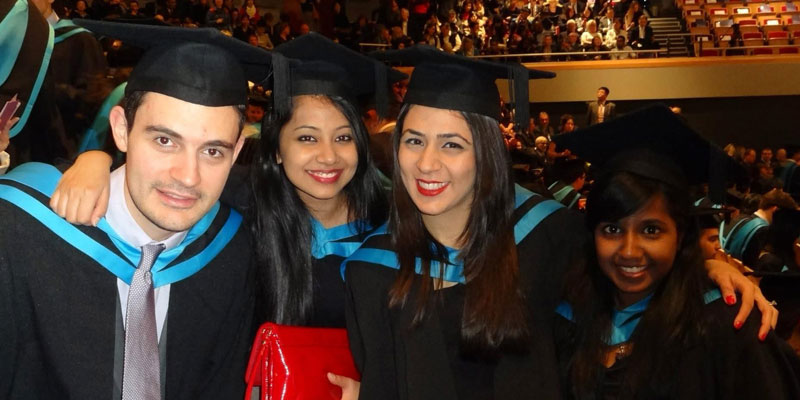
But the environment encouraged collaboration and she was able to pair her learning with the strengths of her peers from around the world, making lifelong friends along the way.
“My closest friends still are from Warwick. We were all from different backgrounds, but we were also very like-minded.
“We had occasional weekends away together during our course in places like Edinburgh. And years later, we travel large distances to see each other for reunions and weddings. I’ve just come back from my friend’s wedding in Athens!”
This exposure has proved professionally valuable in Dubai, where multicultural teams are the norm.
Life on Warwick’s campus also offered a degree of independence Farah had not previously experienced. “Warwick was the best year of my life,” she says. The contained, yet international, campus provided both focus and freedom, which she might not have achieved with a more fragmented, multi-site experience at a business school in London.
Career foundations in a tough job market
Farah began her Master’s with a clear ambition to gain experience in the UK’s financial sector. The timing, however, was unfavourable. The lingering effects of the global financial crisis and changes to post-study work visa rules curtailed her plans.
Nevertheless, the job search itself became a form of training. The WBS Careers team played a critical role, offering CV workshops, mock interviews and guidance on navigating what Farah describes as a more “sophisticated” recruitment process in the UK compared with many other markets at that time.
That preparation proved transferable. After a short internship at a consultancy in London, finishing it off remotely in Mumbai, Farah relocated to Dubai, where she joined KPMG.
She knew the Gulf region well, having spent her early years in Bahrain, but it was her WBS experience that was crucial in gaining the role at the Big Four firm.
“The UK application process was so rigorous,” she says. “That’s what actually helped me get my job in Dubai.”
Farah spent more than five years in deal advisory at KPMG, working across mergers and acquisitions, and, in particular, in valuation and transaction services. The experience was intense but formative. Unlike more specialised roles in larger markets, Dubai’s relatively smaller financial ecosystem required versatility.
“You’re more of a jack of all trades,” she says. “I got to do everything as opposed to being typecast in one thing.”
That breadth came with trade-offs – a slower path to specialisation – but also accelerated her overall exposure to corporate finance.
Parallel to her work, she qualified as a chartered accountant, a demanding process that extended her training well into her late twenties. “It was brutal,” she says, though ultimately worthwhile.
“All that hard work does pay off.”
Seeking a more stable lifestyle and closer engagement with business outcomes, Farah then moved into industry, first with multinational technology firm Cisco and later with Schneider Electric. The transition marked a shift from advising on transactions to influencing ongoing performance.
As a Finance Business Partner – “a junior CFO role”, as she describes it – the WBS graduate is responsible for analysing revenue, costs and profitability, and advising management accordingly.
Her assessments of business performance inform the big decisions. “I’m a trusted advisor,” she says. “I enjoy influencing people on those decisions for the betterment of the business.”
The role also demands scenario planning in volatile conditions. Recent geopolitical tensions in the region, including the disruption to shipping and rising costs caused by the standoff in the Strait of Hormuz, have required reassessment of forecasts and strategies.
“You’re building best-case and worst-case scenarios, trying to foresee risks that haven’t materialised yet,” she says.
Here again, the analytical frameworks developed at WBS – from econometrics to game theory – underpin her approach.
Professional identity
More than a decade after graduating, Farah still places her Master’s prominently on her curriculum vitae. While she emphasises that professional success ultimately depends on experience, she credits Warwick with providing the tools and confidence to begin. The MSc Economics and Finance is “part of my identity”, she says.
It was the collaborative environment of Warwick that she also keeps with her. “You don’t just learn from the course,” she says. “You learn from other students who have come from different cultures and nationalities.
“And then you realise that you have made lifelong friendships.”
Back in Dubai, as negotiations unfold and decisions loom, those friendships and those lessons continue to resonate. Sometimes that is in meeting stakeholders from different parts of the world. Sometimes it is in the language of balance sheets. And sometimes, with an eye for cooperation over conflict, it is in the logic of that very influential WBS module that looked at game theory.
Discover more about Warwick Business School’s Master's Courses.
 X
X Facebook
 LinkedIn
 YouTube
 Instagram
 Tiktok