



Patient focus: Region Jönköping in Sweden has built one of the world's best health systems
For more than 40 years, Region Jönköping in southern Sweden has built and sustained one of the world's highest-performing health and care systems.
Of all 21 Swedish health and care regions, Jönköping holds the strongest public trust, the shortest waiting times and is among the highest performing in terms of clinical results and patient satisfaction, including in relation to healthcare equity.
It also achieves the strongest financial performance, is among the highest-performing for cost-effectiveness and succeeded in building three hospitals without financial loans.
This continuous quality is reflected in the fact that it is a four-time winner of Sweden’s national quality award, which is prized across both public and private sectors.
With an improvement strategy of relentless curiosity and development of ‘simple rules’, Region Jönköping has moved from being a functional healthcare system to one that is patient and process-oriented.
So, what does it actually take to continually make enduring improvements across a whole system? And what can other systems, such as the English National Health Service (NHS) learn from Region Jönköping?
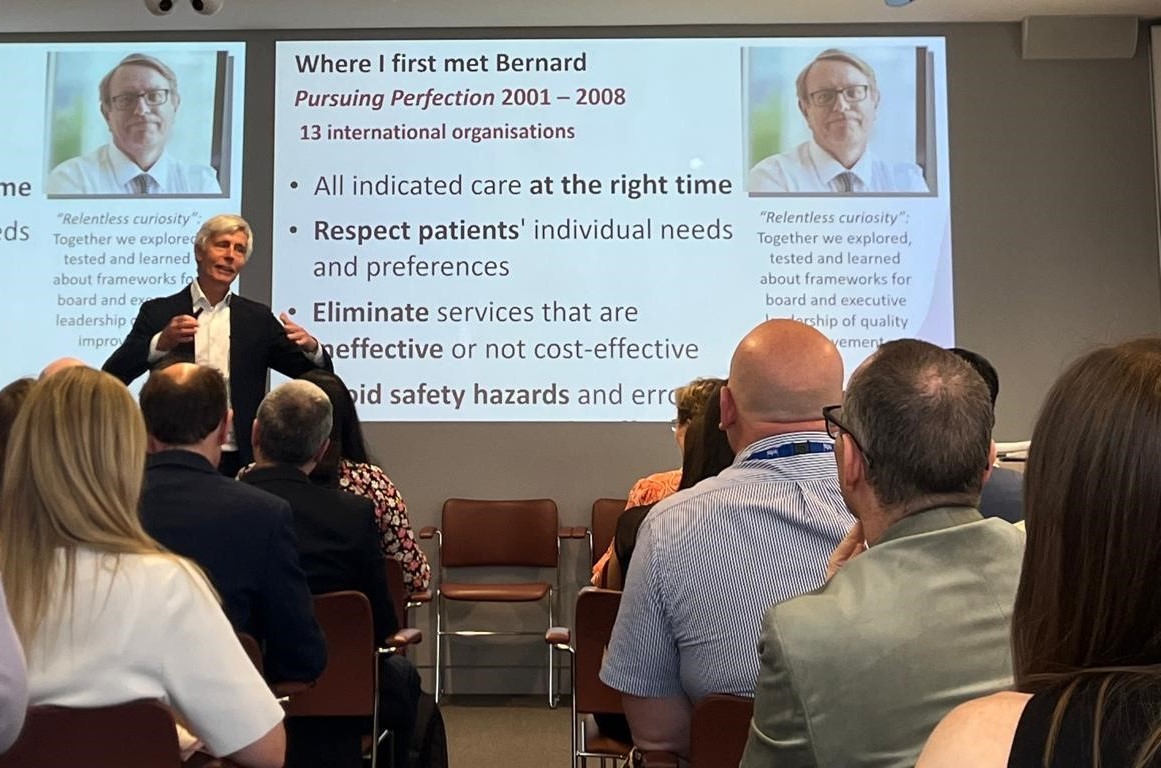
To answer these questions, Warwick Business School's Centre for Organising Health and Care Research assembled more than 100 health and care leaders from practice, policy and academia for the inaugural Bernard Crump Memorial Masterclass at WBS London at The Shard.
The aim was to build on Professor Crump’s legacy as the first CEO of the NHS Institute of Innovation and Improvement and an Emeritus Professor at Warwick Business School.
We were joined by Göran Henriks, a Senior Fellow of the Institute for Healthcare Improvement, who serves as Strategic Adviser to Region Jönköping and is one of the principal architects behind its transformation.
In his keynote presentation, Mr Henriks identified nine ingredients of Region Jönköping’s “secret sauce” which have helped it to sustain measurable, system-wide improvement over four decades.
These were discussed by healthcare leaders together with insights from a panel of academics from Warwick Business School, Warwick Medical School, the University of York and Aston University.
What is best for Esther?
The transformation in Jönköping began with a story. In 1996, a physician named Mats Bojestig described an emergency room that was overwhelmed and regarded as the worst hospital in the region.
Jönköping leaders walked the fragmented journey of Esther, an 82-year-old woman who had spent 12 hours being passed between numerous health and care services, with no food, duplicate tests and little attention. They realised there was an urgent need to address this lack of service integration and dignity for hundreds of patients like Esther.
The response was to ask a new question, ‘What is best for Esther?’
This became the governing principle of the entire system. It led to each team carefully considering the processes before and after the phase they were responsible for.
This reoriented every team from an organisational logic, arranged around institutional departments and professional hierarchies, to a logic that was organised around the patient's journey through the health and care system.
Thirty years later, Esther’s story has evolved to include representations of other patients, commonly referred to as ‘Esther’s family and friends’, and has travelled internationally. The Esther Principle remains the most important ingredient in Jönköping and the one that requires genuine and shared commitment at every level of leadership.
The idea of asking 'What is best for Esther?’ resonated across all of our group discussions as a value statement for teams, leaders and boards across health and care organisations. This could enable the development of patient-centred language in strategies to structurally reorganise leadership accountability and frontline practice.
The opportunities identified from focusing on and creating patient-centred pathways included breaking down silos and enhancing partnership working.
The inspiring origins of the Jönköping story set the scene for many more Esthers to be discovered, and for their journeys to be mapped and revisited to create powerful impact across more health and care systems.
Quality as strategy, not as a programme
One of the most important ingredients in the Jönköping recipe is the positioning of quality improvement as the overarching leadership philosophy rather than a distinct programme.
In Jönköping, quality improvement is at the core of how the system is governed. This philosophy can be seen in three strategic initiatives.
All 550 leaders across the system meet five times a year to work together on strategic improvement objectives in sessions structured around clinical and operational challenges of the system.
Almost all CEOs in the Region Jonkoping system are required to hold a Master's degree in improvement. There is substantial investment in the learning infrastructure, through:
- Qulturum, a dedicated meeting place for leadership development, learning and innovation
- Futurum, a research and development centre
- An Academy
- An Advanced Training Programme for clinical process development.
The collective impact of investing in and enacting quality as a strategy means that improvement work no longer operates as a distinct specialism conducted by experts; it is an integral part of each person’s day-to-day responsibilities.
The discussion groups during the masterclass emphasised the importance of extending its reach from hospitals to the broader system to consistently include primary care, community, and social care settings.
They also identified the need to bring leaders from across diverse organisations together; for all leaders to have improvement qualifications and engage with improvement science methodologies; and for improvement to be embedded in every role, including within finance departments.
Jönköping leaders made explicit promises of stability and stayed true to them. New ideas were incorporated through a "Lego strategy" that built on the core philosophy rather than abandoning what came before.
This enabled the system to accumulate capability. While other Swedish health systems experienced repeated structural upheaval, Jönköping carefully planned its leadership succession, and quality leadership became a professional expectation rather than a personal preference.
Across our discussion groups, experts agreed that constancy of purpose was the most important ingredient.
However, they admitted that it was also the most difficult to sustain in the context of the UK health and care system, which consistently had to contend with shifting political priorities, continual structural change, short-term targets, and short leadership tenure. This meant momentum was repeatedly disrupted by vested interests and an “addiction to chasing the next silver bullet.”
Holding the tensions
The success of our Swedish counterparts may offer useful lessons in how to overcome these challenges.
Mr Henriks highlighted inherent tensions that needed to be worked with throughout Jönköping’s four-decade journey, rather than trying to eradicate or ignore them.
Similarly, our group discussions and academic panel identified tensions across health and care systems in the UK that cannot be resolved by prioritising one side. Three sets of competing tensions stood out that need to be navigated simultaneously.
The first was the tension between standardisation and innovation. Group discussions highlighted that the lack of additional resources meant it was often difficult to devote sufficient energy to “improving the day job” alongside “doing the day job.”
In order to achieve this, Jönköping operates with clear standards and rigorous measurement while creating dedicated space for experimentation and renewal.
Three modes were articulated: doing things well, doing things better, and doing better things, with all three required to achieve substantive ongoing improvements.
Health and care systems that focus exclusively on compliance with standards will not innovate; those that pursue innovation without standardisation will not sustain improvements.
The second tension existed between top-down strategic alignment and frontline agency. Jönköping balances these through simple rules, governing principles that provide coherence and direction without prescribing behaviour, to harness grass-roots energy.
As Mr Henriks emphasised: "You cannot talk and plan your way into a new way of acting. However, you can act your way into a new way of thinking."
The challenge for frontline practitioners of rarely being given genuine permission to lead change was noted in several group discussions.
The final tension arose between prioritising the technical and social aspects of improvement journeys.
For Mr Henriks, this is embodied in his expert position in both finance and psychology. This duality has underpinned all chapters of Jönköping's improvement story: prioritising data dashboards and key indicators while at the same time maintaining focus on the cornerstones of individual patient dignity and developing relationships.
Our group discussions highlighted professional anxiety about rapid technological development, with a concern that “AI changes everything”. There was a desire to reframe digital as an enabler rather than a goal and a need for “more transitional support”, including with interpreting data.
Improvement with citizens
The value assigned to patients’ lived experience in Jönköping, which began with the development of the Esther Principle, has been extended to involve citizens more directly in health and care delivery and the system’s improvement journey.
The Esther Principle has evolved to be ‘citizen driven care’. In health and care delivery, strategies have been implemented that mean patients have enhanced power and influence in day-to-day decisions about their health.
This is reflected in the ‘patient compact’ policy that focuses on collaborative approach, allowing patients to communicate 'what’s important for me’ to healthcare providers, and implementing self-selected hospital admission processes in relation to mental health.
Jönköping has extended its patient-focus to directly include more than 100 citizens in improvement work.
Citizens with diverse clinical needs and from a broad range of socioeconomic backgrounds receive payment for their direct role in co-creating change. Through co-production with community partnerships, Jönköping has developed family centres, youth clinics, and school-based health programmes, firmly positioning citizens’ holistic experiences, including broader social and psychological elements that contribute to overall wellbeing, as a healthcare issue.
In reflecting on the lessons from Jönköping, attendees identified a goal to improve community agency by developing partnerships with voluntary sector organisations and working with patients, (including children, young people and their parents) as equal partners.
This included involving them in Plan – Do – Study - Act (‘PDSA’) cycles and engaging with patients in “measurement for improvement”. Integrating co-production with citizens who are ‘most in need’ is a necessary component of quality improvement to ‘sharpen focus’ on equity and ensure health inequalities do not remain invisible.
What health and care leaders can do to drive improvement
The group discussions generated a set of practical actions to sustain long-term improvement and system change.
Immediate: Commit to constancy of purpose. Identify the governing question, the equivalent of "what is best for Esther?" This would orient every team's improvement work to patients’ experiences through the system.
Make explicit what your organisation will build on and what it will not abandon, however strong the pressure to pivot.
Over the next 12 months: Align strategic objectives to improvement work and develop the learning infrastructure. Make improvement part of everybody's working day. Enable teams to improve their processes for the benefit of patients.
Build measurement systems with lead indicators and make variation visible to highlight inequities. Engage clinical teams and finance teams in a shared conversation about the value of continuous improvement to co-create an economic and social case together. Invest in co-production, to create meaningful collaboration and partnership, including with members of communities experiencing the greatest need.
Over the next decade: Build the conditions for dynamic stability. Develop leadership that is collective and embedded in daily work guided by co-created simple rules.
Work in partnership across organisational and sector boundaries, including health, local government, social care, education, and community organisations, with a focus on the wider determinants of health. Move from a system organised around what services do to a system organised around what good lives require.
The palpable energy throughout the masterclass indicated the shared enthusiasm among health and care leaders for embedding the learning from Mr Henriks’ Jönköping story.
However, participants highlighted political, cultural, and structural conditions that might act as barriers to implementing the Jönköping recipe for success.
They reflected on the fact that Jönköping’s population was relatively small and more homogeneous than that of the UK. They also emphasised the challenges posed by regulation, change fatigue, limited resources, and accountability structures in the UK.
Despite this, there was a belief that sustained high performance in healthcare is achievable. It will require a genuine long-term commitment to quality improvement as a system strategy rather than a separate programme. But this can be created and maintained by leaders who care, who embrace curiosity, and who work together.
The first WBS Centre for Organising Health and Care Research Bernard Crump Memorial Masterclass was established to honour a leader who devoted his career to bridging practice and research to create new understandings to improve health and care systems.
The masterclass embodied Bernard’s ethos, energy and commitment, bringing together leaders from both practice and research communities in a shared endeavour of building better health and care systems.
For further information about The Centre for Organising Health and Care Research at Warwick Business School visit the website or contact cohcr@wbs.ac.uk.
Discover more about healthcare and leadership. Receive our Core Insights newsletter via email or LinkedIn.
Choose Warwick Business School as a preferred source of trusted insights in your Google searches.
 X
 Facebook
 LinkedIn
 YouTube
 Instagram
 Tiktok