
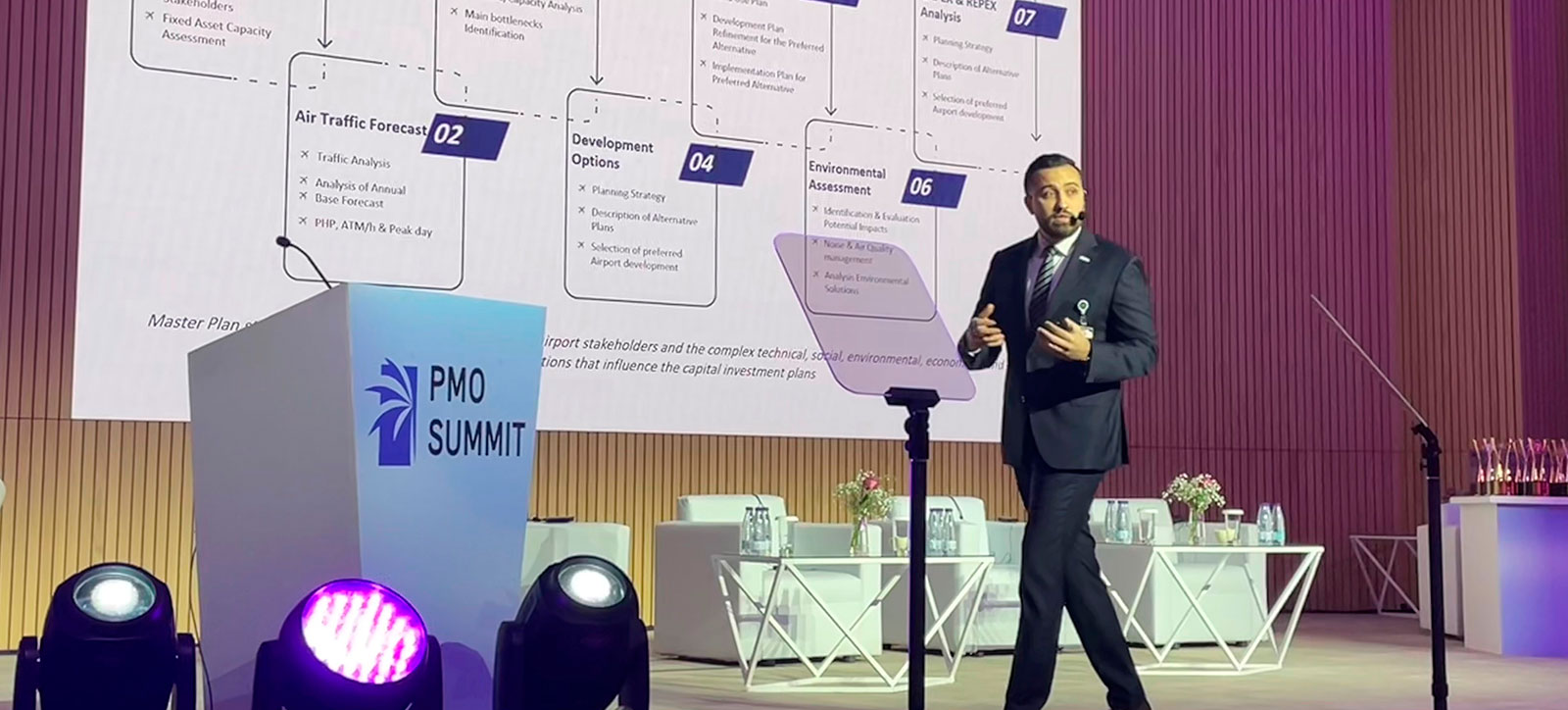
Communication: Whether speaking the language of finance or explaining the long-term story of an airport, Moulham says the MBA helped him 'translate' across disciplines
When Moulham Zahabi reflects on the past few years of his career, he returns to a deceptively simple maxim: ‘You don’t need certainty about outcomes, only clarity on action’.
It is a line that has become a professional compass for the Saudi aviation specialist – one sharpened, he says, during his MBA at Warwick Business School (WBS).
Moulham, now 35, has spent his career in the intricate world of airport development, a sector where long-term planning collides daily with operational unpredictability. Between 2020 and 2022, as the pandemic upended global travel, he decided to pursue a Full-time MBA at Warwick. The timing, he admits, was unusual. The impact, he insists, was transformative.
“The Strategic Thinking module during my MBA really stuck with me,” he says. “In today’s very uncertain world, it’s having that solid plan and being able to project it that wins the trust of the executives around you, even though in reality, everything could change. If the people around you have faith, then you are fully empowered to deliver impact.”
That confidence would soon be tested. After completing his MBA, Moulham took up the role of Director of Airport Master Planning at Matarat, Saudi Arabia’s Civil Aviation Holding Company responsible for operating 27 airports across the kingdom. It was a pivotal moment for the sector: passenger numbers were rebounding after Covid-19, and the government’s Vision 2030 programme was accelerating investment in infrastructure, tourism and logistics.
Yet it was not strategy alone that propelled him into the role. During his MBA, a Business Analytics module had sparked an idea that would later become his patented technology. “It was near the end of Covid and a lot of airport systems were struggling to cope with the renewed influx of passengers. So it was a perfect opportunity to explore advanced technology adoption in airports.”
Working with King Khalid International Airport in Riyadh, Amazon Web Services and other partners, Moulham led the development of an AI-powered system capable of predicting failures in baggage-handling equipment 30 or more days before they occurred. The project, he says, “generated some extra noise” – enough that, in October 2022, he was asked to oversee master planning for the entire national airport network under the leadership of a visionary Executive Vice President for Projects & Technical Affairs, Turki Al Mubadal.
The MBA mindset
What followed were three intense years of designing long-term airport development strategies, building asset management systems and shaping a capital investment portfolio worth around $19.4 billion. The work required fluency not only in operations but also in corporate finance and strategy – areas where Moulham credits his MBA with expanding his toolkit.
“The MBA introduced me to thinking that I hadn’t been exposed to before,” he says. “Finance, strategy, how financial statements work, and in a range of case studies that broadened my thinking in terms of structured decision-making.”
Those skills, he adds, proved essential when working with engineers and company executives to optimise capital programmes, set competitive tariffs for airlines and passengers, deliver world-class customer experience, and ensure airport assets remained safe, reliable and fit-for-purpose.
One of the most valuable lessons, he says, was learning how to shift between conceptual thinking and practical execution. “Warwick taught me how to move between the two levels back and forth like a helicopter,” he says.
“How to stay high and have the vision of where you need to go, being critical and analytical, but also knowing when there’s a problem that requires attention closer to the ground.”
Communication too became a central part of his leadership approach. Whether speaking the language of finance to financiers or explaining the long-term story of an airport to the Board of Directors, Moulham says the MBA helped him “translate” across disciplines – a skill that proved vital as Matarat sought to build what he describes as a “a corporate culture that works”.
The state-owned organisation is predominantly Saudi with expatriates making up less than five per cent of the workforce and has doubled its headcount in three short years. Given the competition for specialised talent across the Kingdom, this meant employing a large number of ambitious employees without aviation-specific industry experience and assimilating them into the cultural thinking of the organisation.
This chimed with the dissertation he wrote for his MBA – The role of Corporate Culture in an Era of Rapid Growth.
“For an organisation to succeed during disruption, whether it’s positive or negative disruption, you need to have the right mindset, the right group of people who can work together when systems lag behind growth or perhaps, they simply don’t exist yet,” says Moulham.
Vision 2030
The country where Moulham was born and raised after his parents left Lebanon in the 1980s has been going through its own era of rapid growth recently.
The Kingdom of Saudi Arabia (KSA) has set out an agenda for sustainable economic and social change under its Vision 2030 programme, investing in giga-projects such as NEOM, a zero-carbon smart city stretching lineally across the desert for 170km to the Red Sea.
These projects have helped to fuel the aviation sector in the Kingdom – the sector that Moulham continues to dedicate his life to, now as Associate Director of Aviation KSA at EGIS Engineering & Consulting Group.
One of the airports the consultant is most enthusiastic about has been the Abha Airport Project, part of Saudi Arabia’s efforts to boost tourism to the green mountainous region of Aseer and a project that Moulham worked on at Matarat.
“With the new Abha Airport - designed by Foster & Partners - the Kingdom’s leadership opted for a terminal that reflected the vernacular architecture: rugged exteriors, colourful geometry, airy courtyards and small windows that reflect local heritage and culture – specifically a beautiful and well-preserved Aseeri village called Rijal Almaa.”
For Moulham this project slated for completion in 2028 offers a model for what he sees as the next phase of Vision 2030: development that is modern yet rooted in place.
“Saudi Arabia’s Vision 2030 has really opened up the economy to a younger generation of homegrown talent including a huge increase in female workforce participation,” he says.
“As a result, there are opportunities for western educational institutions to step into the market to support this young talent.
WBS is among those already active in the region, delivering programmes for KSA-based clients in both the UK and in the Kingdom. Moulham believes such partnerships will be increasingly important. “We need a bespoke mix of theory and practice in the context of the change that is happening,” he says.
For him, the question is not whether international institutions can contribute, but how they will adapt. “I’m also excited to see how these institutions balance the building of professional confidence among our younger executives with an appreciation of local cultural values and of the local context.”
As Saudi Arabia continues its rapid transformation, Moulham’s own trajectory – from MBA student to aviation strategist and consultant – reflects the broader story of a country seeking to combine global expertise with homegrown ambition.
And if his guiding principle is any indication, he intends to keep navigating that uncertainty with a clear sense of purpose: always knowing what needs to be done, even when the future remains in flux.
Discover more about Warwick Business School's Change Makers.
 X
X Facebook
 LinkedIn
 YouTube
 Instagram
 Tiktok