Life at WBS: Master's students share their first-term experience
Kira and Diala reflect on their first semester at WBS, sharing honest insights into academics, student life, and advice for future students.



MSc Management student August shares her experience of studying at Warwick Business School and reflects on how the internship pathway helped bridge academic learning with professional experience.
Studying MSc Management at WBS was an expansive and intellectually demanding experience. The programme exposed me to a wide range of subjects that helped build a strong understanding of how organisations operate within complex global markets.
During the programme I studied modules such as Data Driven Decision Making, Performance Management of the Firm, Customer Value Management, Strategies for the Global Economy, Leading and Managing Change, and Purpose, Impact and Profits. Each of these modules offered different frameworks for analysing business problems, from quantitative decision making to understanding how organisations navigate global economic and political environments.
One of the most valuable aspects of studying at WBS was the way the programme encouraged students to think critically about real-world challenges. Many of the discussions in class extended beyond theory and into questions of strategy, governance and market behaviour. The international nature of the student cohort also made the experience particularly enriching, as discussions often included perspectives from different industries, countries and professional backgrounds.
Beyond the classroom, WBS provided numerous opportunities to engage with industry professionals through guest lectures, networking sessions and career development events. These experiences helped connect academic learning with practical career pathways and allowed students to start thinking more intentionally about the industries and roles they wanted to pursue after graduation.
From the beginning of the curriculum I knew I wanted to pursue the internship pathway for my capstone module because it aligned closely with my academic background and professional interests.
My undergraduate studies were in Philosophy, Politics and Economics, and I have always been interested in the intersection between politics, public policy and global business strategy. The internship route offered the opportunity to explore those interests in a professional setting while still benefitting from the academic structure of the MSc programme. The internship option also allowed me to apply what I was learning in the classroom to real organisational environments. Concepts discussed in modules such as Strategies for the Global Economy and Data Driven Decision Making became much more tangible when you could see how organisations actually interpret political developments, regulatory change and market dynamics when making strategic decisions.
If I am being completely honest, the location also played a role in my decision. London is one of the world’s most important financial and political centres. Being able to gain professional experience in that environment while completing the MSc programme was an opportunity that was difficult to resist.
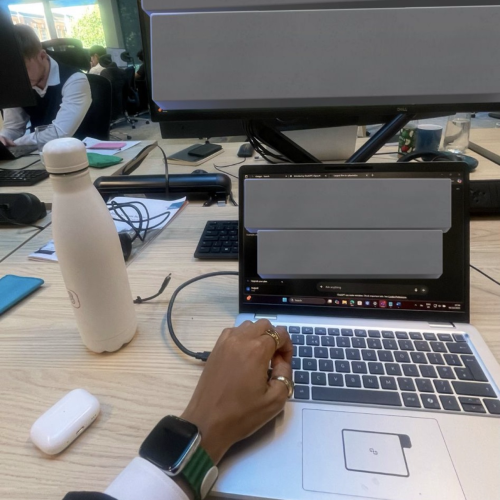
I secured my internship through the 10,000 Black Interns initiative, an organisation that supports Black students across the UK in accessing professional opportunities. The programme plays an important role in widening access to industries that can often feel difficult to enter without established networks.
Through the programme I joined Flint Global, a strategic advisory firm that helps companies navigate complex political, regulatory and policy environments. What initially attracted me to the company was the subject matter of its work. Flint operates at the intersection of politics, public policy and global business strategy, which aligned directly with both my academic interests and my background in political economy.
I was also impressed by the calibre of the team. Many of the professionals working at the firm had studied at Oxford, Cambridge or other leading UK universities. Being surrounded by individuals with strong academic and analytical backgrounds created an environment where rigorous thinking and intellectual curiosity were clearly valued.
Because Flint is a boutique advisory firm, I knew that securing the opportunity might require persistence. After the second stage of the interview process it took about a month before I hear anything further.
During that time I followed up politely and professionally to ask whether there were any updates or next steps. I later learned that because of the busyness of the team I was in fact one of only a handful of candidates selected to be interviewed, which reinforced the importance of persistence and professional follow-up when pursuing opportunities.
The internship itself was an incredibly valuable learning experience. During my time at Flint Global I supported research and monitoring work across several sectors, helping track political and regulatory developments and contributing to analytical briefings.
The work required quickly understanding complex policy environments and translating those developments into insights that could be useful for clients.
One of the most interesting aspects of the internship was how it shaped my academic research. The experience strongly influenced the topic of my dissertation, which examined the relationship between political instability and foreign direct investment in emerging economies, with a focus on South Africa’s energy sector. Being immersed in an environment in which discussions about political risk, regulation and investment flows were happening daily helped refine the research questions I wanted to explore academically.
Some of the individuals I interviewed during my dissertation research were professionals from my workplace, which added valuable real-world insight to the research. The dissertation ultimately received a distinction, and I believe the practical exposure from the internship played an important role in strengthening both the relevance and depth of the research.
Like any professional environment, the internship also presented challenges. The pace of work could be fast, and balancing multiple tasks while maintaining attention to detail required strong time management and organisation. However, those challenges were also part of what made the experience so valuable, as they helped develop skills that are difficult to replicate in purely academic settings.
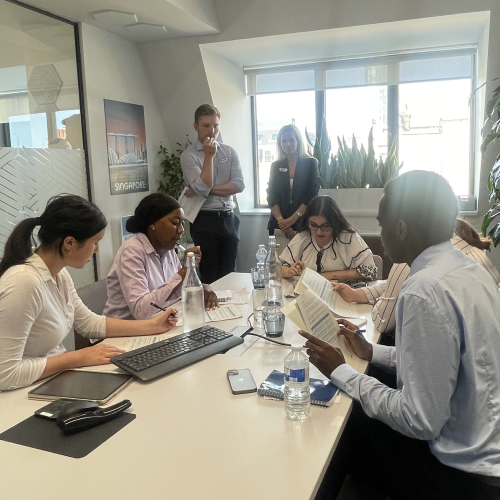
I would strongly recommend the internship route to future students. Any opportunity to gain experience within a professional environment is extremely valuable because it exposes you to how organisations actually operate and make decisions.
Beyond the technical knowledge you gain, internships also teach persistence, resilience and professionalism. One of the most important lessons I learned is that opportunities often require consistent effort, follow-ups and a clear sense of what you want to achieve.
My advice to future students would be to be proactive and intentional when searching for opportunities. Programmes such as 10,000 Black Interns are incredibly valuable, but personal initiative and persistence are still essential. Being clear about your interests and continuing to pursue opportunities even when the process takes time can make a significant difference.
Ultimately, the internship route adds a practical dimension to the MSc Management programme. It allows students to apply classroom learning to real professional environments while also gaining valuable insight into the industries and roles they may want to pursue after graduation.
Kira and Diala reflect on their first semester at WBS, sharing honest insights into academics, student life, and advice for future students.
MSc Business with Marketing student, Raghav Gupta, sat down with us to discuss how his WBS journey has been so far.
Current MSc students Boluwatife and Supavadee share their experiences of their first term at Warwick Business School.
 X
X Facebook
 LinkedIn
 YouTube
 Instagram
 Tiktok