

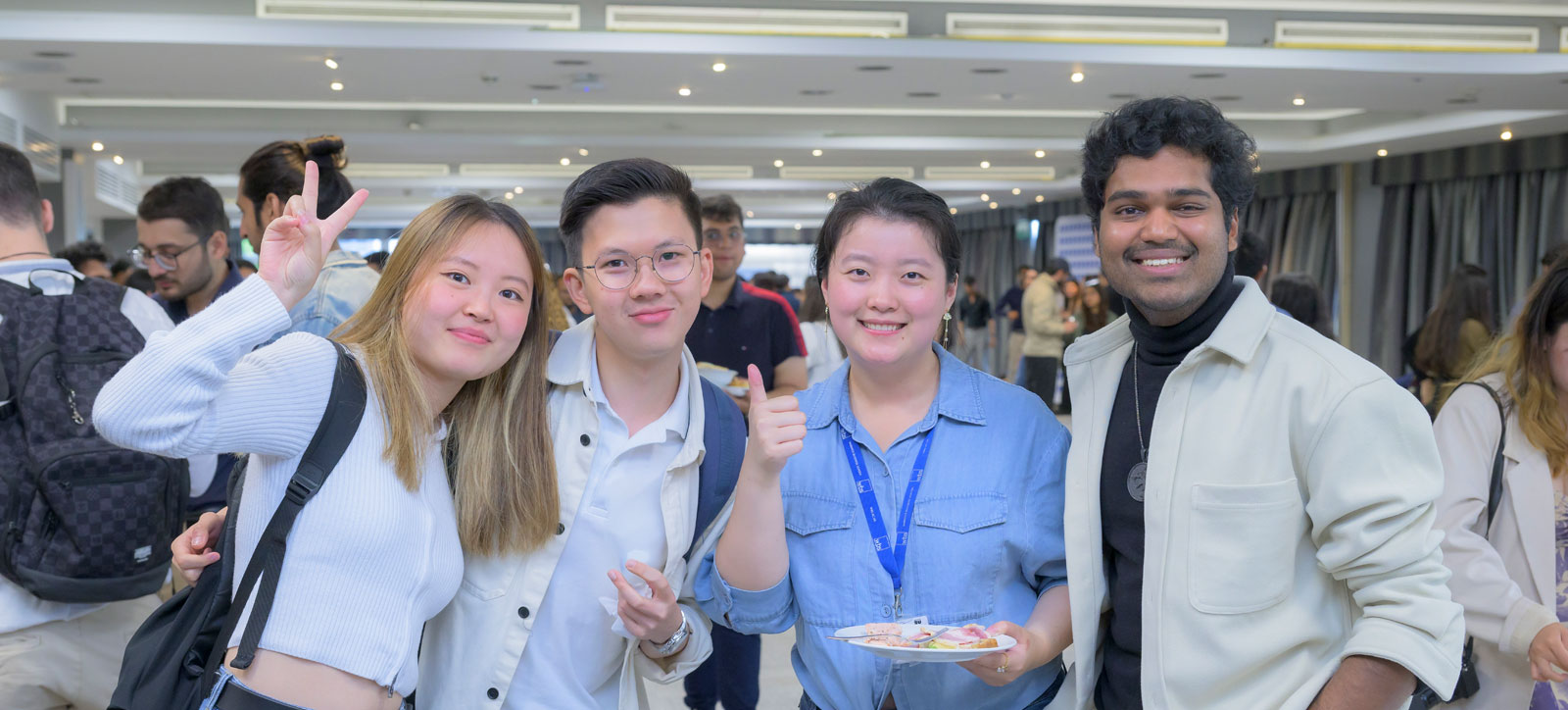
Fair play: MSc International Business students have plenty of networking opportunities such as career fairs and treks
For graduates looking to shape a career across borders, the MSc International Business has become one of the most versatile postgraduate options.
Rather than funnelling students into a single niche, the degree develops a panoramic understanding of how multinational corporations and other businesses operate and compete across global markets.
And Warwick Business School’s latest MSc Employment Report for the Graduating Class of 2025 shows that the generalist advantage of the MSc International Business translates into tangible, wide-ranging career opportunities at companies like Amazon, Mars, and Goldman Sachs.
Course Director Darren Sparkes, Associate Professor of Accounting, said: “The year-long course gives students the strategic insight and global awareness needed to navigate complex international markets with confidence.
“It blends rigorous academic theory with real-world application, helping students explore the challenges faced by economies worldwide. Through case studies, practical exercises, and a diverse portfolio of modules - from Consumer Behaviour to Corporate Finance - students develop a deep understanding of global business dynamics and the skills required to thrive in internationally focused roles.”
Job opportunities for MSc International Business graduates
The latest WBS Master’s employment report shows the top sectors that graduates move into after graduating with an MSc International Business are marketing, manufacturing, consulting, and finance. Many use the degree as a launchpad into global-facing roles such as:
- Consultant
- Head of Sales & Marketing
- Human Resources Manager
- Investment Associate
- Senior Analyst
- Marketing Director
- Research Executive
The average salary of the course’s 2025 graduates is $61,300 when adjusted for purchasing power parity (PPP) as they secured jobs all over the world.
The diversity of roles reflects how an MSc International Business gives students options, with a year to explore their passions and interests before choosing their path. It also gives students the adaptability to pursue opportunities wherever global business is evolving and to change tack when needed.
Peter Burnham, Master’s Careers Manager at WBS, said: “That’s the nature of International Business - broad, flexible, and full of optionality.
“The course opens up a broad array of opportunities; you're not pigeonholing yourself. We see from the career destinations that whether you want to work in finance, marketing, supply chain management, or other areas, doing a course like MSc International Business keeps your options open with the skills and knowledge that apply to careers in many areas.”
Why employers value an MSc in International Business
Employers hiring for globally oriented roles - particularly multinational corporations - increasingly seek graduates who can interpret trends, navigate uncertainty, and work confidently across cultures. The skills developed on the course map directly onto this demand.
Mr Burnham said: “UK employers don’t select by degree title; they select for potential. They want teamwork, resilience, leadership, and commercial awareness. The degree helps students evidence those capabilities.
“And although there has been a retreat from globalisation, most companies have to consider overseas markets, so having an understanding of the different cultures and ways of doing business around the globe will also help graduates in the job market.”
In countries such as China and India the qualification carries even more weight, helping graduates stand out and open doors to top positions that would otherwise be closed. In such countries an MSc often functions as a required certificate for senior graduate positions.
Career skills developed during an MSc International Business
As well as the eight core modules that range from International Business Strategy and Marketing in an International Environment to Fundamentals of Economic Behaviour and Foundations of Financial & Management Accounting, students can choose two optional modules from a vast range of subjects including Design Thinking, Entrepreneurship and Business Venturing, Project Management and Sustainable Innovation.
Warwick also enhances employability through its PRACTICE framework. This is an acronym for eight skill pillars – Professionalism, Responsibility, Analytical thinking, Critical thinking, Teamwork, Innovation & Creativity, Communication, and Emotional intelligence.
Mr Burnham added: “Before students even step on campus, they can attend the MSc Careers Summer School, which is a series of four online induction sessions covering the job market, crafting impactful CVs and cover letters; distinguishing yourself from the competition; succeeding in interviews and assessment centres, and more.
“The students then have a career induction when they arrive, and then for every module the PRACTICE framework will be introduced with different elements of it covered. So, one module may see the careers team work on critical thinking with the students and the next it will be professionalism.”
How networking accelerates global career paths
Networking is not a 'nice to have'; it is essential preparation for securing roles across borders.
“If you’ve had 10 conversations with people in your target field, you naturally tend to speak the language of that field in an interview,” said Mr Burnham. “Without that, it’s much harder. So, we will help the students with events and tips on targeting the people they need to network with.”
Warwick supports MSc International Business students build their network with international career treks to Beijing, Shanghai, and Hong Kong for company visits with employers including tech giants Tencent and ByteDance, as well as airline Cathay Pacific. In addition, they can also go to Dubai to take part in the WBS Careers Case Challenge with Emirates airline and more company visits. Plus, the WBS CaeersPlus team will be holding a virtual careers fair connecting Master’s students with 50 Indian employers.
Students can also attend alumni events on campus and across major global cities like Mumbai, Beijing, Milan, and Vancouver, where they can quiz alumni on how they have gained top jobs.
In addition, the School has an International Careers Manager who coaches students on how to build relationships inside multinational organisations and gain jobs outside of the UK, particularly in Asia, where relationship building is deeply valued.
“The trips abroad can be really valuable for students,” said Mr Burnham. “At the case competition with Emirates in Dubai, students get to present to Emirates senior managers. It helps them build confidence and a network with the company.
“The China trek also allows students to network with top firms like Huawei, and we have seen that they get fast-tracked through recruitment processes because they've been on that.”
The School also has specialist support and events for overseas students looking to take up jobs in the UK after graduating.
The CareersPlus team helps with visa requirements and verified sponsored ‘skilled worker visa’ opportunities at companies like financial services giants PwC and Deloitte.
Where do MSc International Business Warwick graduates work?
The WBS CareersPlus team work hard to help students move into the careers they dream of with 63 per cent securing a job before they have even finished the course.
And the broad nature of the programme means students enter a wide variety of sectors from global supply chain management to international human resource management and even finance.
“MSc International Business graduates tend to take on commercial, analytical or client facing roles in finance rather than highly technical ones,” said Mr Burnham. “Graduates have joined major financial institutions in wealth management, product management, corporate banking, and market analysis. Warwick has a strong finance reputation overall.”
The course also gives students the skills to set-up their own business. Though most students have used their first graduate role to give them some experience, according to Mr Burnham “the degree gives them the global mindset to build towards global entrepreneurship”.
What gives MSc International Business graduates an edge?
Three advantages stand out for MSc International Business graduates:
1 Breadth with purpose
Students gain credibility across functions, from strategy to marketing, and even consulting and operations if they choose. This makes them strong candidates for graduate jobs that sees them experience different departments as part of their training.
2 Cross-cultural competence
With 20-plus nationalities in a typical cohort, the degree develops the global fluency employers increasingly demand.
3 Career infrastructure
Early access to one-to-one coaching, mock interviews, CV guidance, and employer engagement gives students a structured route into competitive graduate markets.
A degree that opens global doors
The MSc International Business is a career-expanding degree designed for graduates who want mobility, breadth, and the opportunity to work with multinational corporations across continents.
Mr Sparkes added: “Having the breadth of subjects in one course is powerful - if students use it wisely this Master’s gives them an advantage in the job market.
“We’ve recently seen graduates step into roles such as Head of Business Development, Marketing Director and Retail Business Analyst at companies like Amazon, Barclays and Octopus Energy - clear evidence of the doors this degree opens.
“Coupled with Warwick Business School’s triple accreditation and strong industry networks, the MSc International Business gives graduates both the credibility and the practical expertise to build a global career.”
Discover more about Warwick Business School’s Master's Courses.
 X
X Facebook
 LinkedIn
 YouTube
 Instagram
 Tiktok