


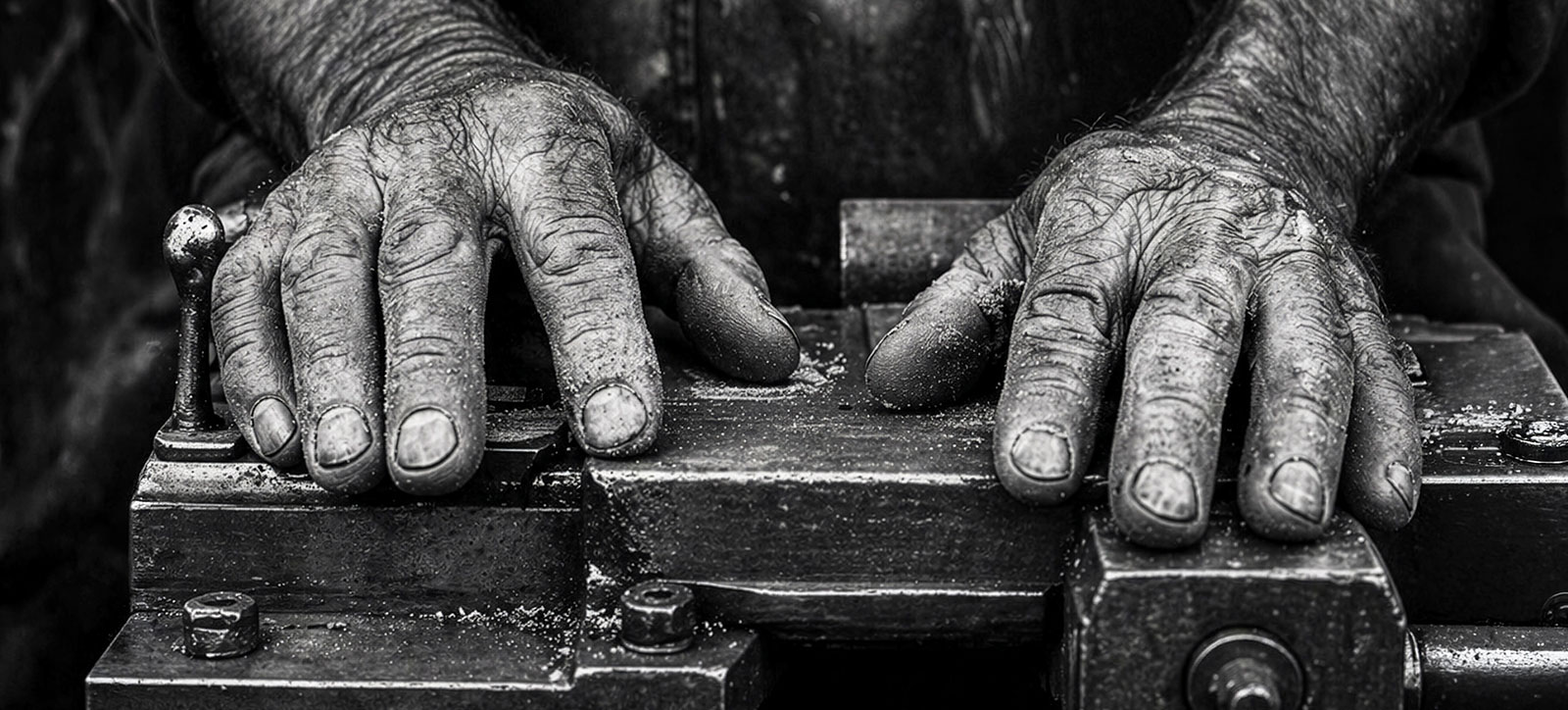
Work of art: Embracing the beauty in low-skilled tasks could help workers to find meaning
The UK is not short of menial jobs. Government statistics show that, by 2027, more than 10 per cent of the workforce is likely to have low-level qualifications or no formal qualifications at all.
As automation and artificial intelligence reshape the job market, many more roles could be reclassified as ‘low-skilled’.
When you think of these jobs, what comes to mind? Many of us imagine monotonous days with little freedom or recognition for workers. This view may be unnecessarily gloomy.
I spent eight months at an unremarkable French factory that makes moulds for the automotive industry and other products.
During that time, I watched the machine operators and fitters on the factory floor as they went about their repetitive and low-paid jobs.
These factory workers had strict working hours, set break times, and largely worked alone. Their actions were closely monitored as they had to swipe a card each time they began a new task.
When do workers find joy in their jobs?
Like many workers in menial roles, they liked to moan about management. Some did the bare minimum to get by, taking additional breaks when the opportunity arose and leaving the machines to run unsupervised.
Yet there were instances when they appeared to enjoy their roles and find meaning in their work. It has previously been suggested that employees in such positions often cope by embracing small acts of resistance, or by reframing their work as a contribution to society.
For example, a rubbish collector may consider themselves as an environmental services provider, emphasising their contribution to cleaner neighbourhoods, public health, and the natural world.
However, I witnessed a different approach: workers managing to find meaning in low-skilled, controlled environments not by resisting or merely coping, but by engaging more deeply with their work through ‘aesthetic improvement’.
They did so by embracing the beauty of the task itself, rather than focusing on its repetitive or controlled nature.
These instances tended to occur when workers took on additional tasks outside of their routine work.
This was not easy to do as their working day allowed for little wriggle room. However, they seized opportunities when production was disrupted, worked through breaks, and even arrived early or stayed late.
Why staff choose to take on additional work
There was no financial reward. Nor were they hoping to improve their prospects of promotion.
So why did they do it? To engage in what the sociologist Richard Sennett defined as craft or the sake of “doing a job well for its own sake”. This allowed them to gain autonomy and recognition at work, two important pillars of meaningful work.
For example, when a machine operator worked through her lunch break to create a new tool that reduced an unsightly mark on a mould, she took pride in presenting it to her grateful colleague.
Suddenly, she was no longer just an executor of repetitive tasks; she had become a designer, contributing to the conception phase of the work.
She later told me: “I love doing challenging things at work where I have to figure things out.”
Similarly, when a fitter spent extra time – outside his paid hours – repolishing a mould that had already passed quality control, simply because “it did not look good” to him, he became the one setting the standards. He decided how the work should be done and when it was truly finished.
In doing so, he gained a sense of autonomy and the prospect that his manager might acknowledge that a new polish was indeed needed.
Should bosses give low-skilled workers more freedom?
If this is possible in a small factory, what does this mean for low-skilled workers in call centres, care homes, or warehouses? Or the ‘click’ workers, who train AI models by clicking a mouse and whose routine work typically lacks recognition and autonomy?
Should we reintroduce the notion of aesthetic judgement in low-skilled, controlled work? Should we allow workers to define when a task is done ‘well’ rather than adhering to rigid, repetitive standards?
Software developers could refine their code until they deem it ‘nice’ rather than merely functional. Call centre operatives could improve their interactions with clients until they judge them ‘good enough’, instead of rigidly following a script that deprives them of all sense of autonomy.
Could moving from measurable objectives to goals based on judgement and appreciation help staff to find meaning in their work?
This would require more time and may also require space for collaboration – things that managers may be reluctant to provide.
In an age of automation, where time is critical and rational choice dominates, is it time to redefine how work is done?
If we prioritise the aesthetic in order to give employees a sense of meaning, perhaps we would achieve better organisational outcomes in the process.
- This article is based on the peer-reviewed research paper Rostain, M. and Clarke, J. (2025) Meaningful work through craft: how workers in low skilled roles engage in anomalous craft to gain autonomy and receive recognition, Organization Studies, Vol. 46, No. 1, pp. 7-34. doi:10.1177/01708406241295504
Further reading:
What companies could lose by replacing junior staff with AI
Removing career barriers for working class women
Two strategies to avoid making yourself replaceable at work
Should companies force workers to return to the office?
Marjolaine Rostain is Assistant Professor in the Information Systems Management Group. She teaches Artificial Intelligence in Business across the Master's portfolio and AI in Business Practices on the Undergraduate programmes.
Learn more about adapting to the impact of AI with the School's two-day Executive Education course AI Leadership programme at WBS London at The Shard.
Discover more about The Future of Work. Receive our Core Insights newsletter via email or LinkedIn.
Choose Warwick Business School as a preferred source of trusted insights in your Google searches.
 X
X Facebook
 LinkedIn
 YouTube
 Instagram
 Tiktok