


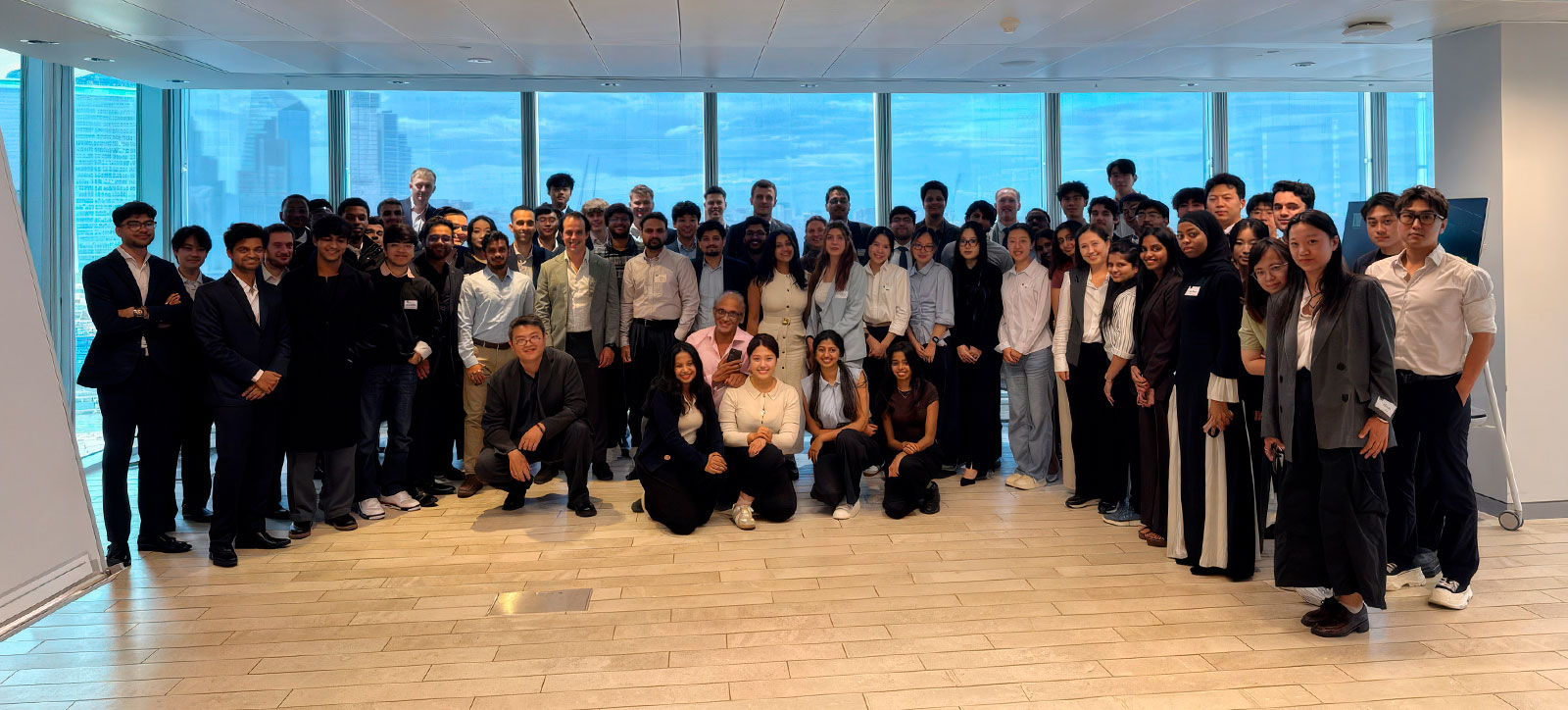
High-tech students: The MSc Financial Technology cohort presenting their FinTech in Practice projects at WBS London at The Shard
Representatives from leading global banks Goldman Sachs and NatWest, Nationwide Building Society, car firm Jaguar Land Rover and financial services giant Deloitte were among the companies in attendance as MSc Financial Technology students delivered their end-of-year presentations.
In total 63 MSc Financial Technology students presented industry projects developed in partnership with 19 fintechs, AI start-ups and major corporations.
The two days of presentations were the conclusion of the two-month capstone module FinTech in Practice that eschews the traditional dissertation in favour of working with companies to tackle real-world problems they are experiencing.
In front of the companies that they researched, and were guided by, students presented their innovative ideas, having put what they learned on the course into practice.
As well as helping students find jobs and build industry contacts, the companies involved left with new ideas and frameworks to test and even implement.
Zsolt Jaczko, Head of Retail IRB Modelling at Nationwide, challenged a group of students to explore how machine learning models could enhance property valuations in retail lending and strengthen their practical application in model-driven decision-making.
He said: "I have been extremely impressed by the students. It was a genuine surprise to see how deeply they engaged with the problem and developed their own solutions.
“Throughout the project, we provided feedback and they adapted quickly. Their learning curve was remarkably steep.
“The work they have presented offers valuable insights, and some of their findings and experiments using public data were particularly interesting. We now have an opportunity to build on their ideas and explore how they can be applied in practice.
“They went well beyond our original thinking on the problem. Their different backgrounds and perspectives enabled them to approach the challenge in ways we had not considered, leading to some very interesting conclusions. This is undoubtedly a project from which we can learn a great deal."
As a case study, Richard Spencer, Advisory Director at Goldman Sachs Asset Management who also sits on the MSc Financial Technology Advisory Board, asked students to use AI agents to identify a promising commercial real estate investment in Tokyo and Seoul.
Students looked to develop an AI-driven framework capable of sourcing, harmonising and analysing disparate data across the cities.
Using a combination of 10 different AI agents Moonie Benyettou, of Algeria, split jobs among them, with one to discover relevant datasets, another to standardise them, and a third to generate scorecards across locations, while others checked for errors at each stage.
Moonie said: “The FinTech in Practice module has been fantastic and very innovative in its design. It has been more than what I expected. Richard, from Goldman Sachs, has been very generous with his time and really helped and guided us.
“It has given me an insight into what top companies expect and so the presentations and reports we have written are industry level.”
Connecting Master's fintech students with industry
With employers nowadays demanding graduates who can apply technical expertise to live business problems, students are seeking exposure to the realities of decision-making inside organisations.
Moris Strub, Associate Professor of Information Systems and Course Director, said: “The module has beaten our expectations. The idea was to bring students together with employers, with relevant projects, and have students learning from industry, gain networking opportunities and give them the platform to shine and maybe something will come out of this for them.
“The individual stories are very moving, with the connections that have been made and with some resulting in job opportunities, it has been heartening to see, and our industry partners are utilising their projects as well.”
The first year of the MSc Financial Technology course has proved a huge success with enrolment expanding to a cohort of 120 students for this academic year.
And the FinTech in Practice module has been challenging but incredibly valuable for students, with projects ranging widely across financial services, artificial intelligence and digital innovation.
One group partnered with AI firm Firemind, which develops agentic AI systems for IT departments. Their task was to assess demand for the company's technology in highly regulated sectors such as financial services.
According to Giao Le, Vice President of Business Development at Firemind, the students' recommendations were immediately useful.
"We are taking the recommendations into our go-to-market strategy," she said. "It has been very valuable and has helped us iterate quickly. At this stage of our company's growth, the pace of learning is very important.
"Automating ticket-based work with agentic AI is only the beginning. The real value is in the hidden risk that AI can reveal. In one of our pilots in Finland, the AI system identified 10,000 security risks that would otherwise have remained hidden and fixed them.
"I particularly liked the students' framework for prioritising workflows. It is very relevant for us and will help guide our future decisions."
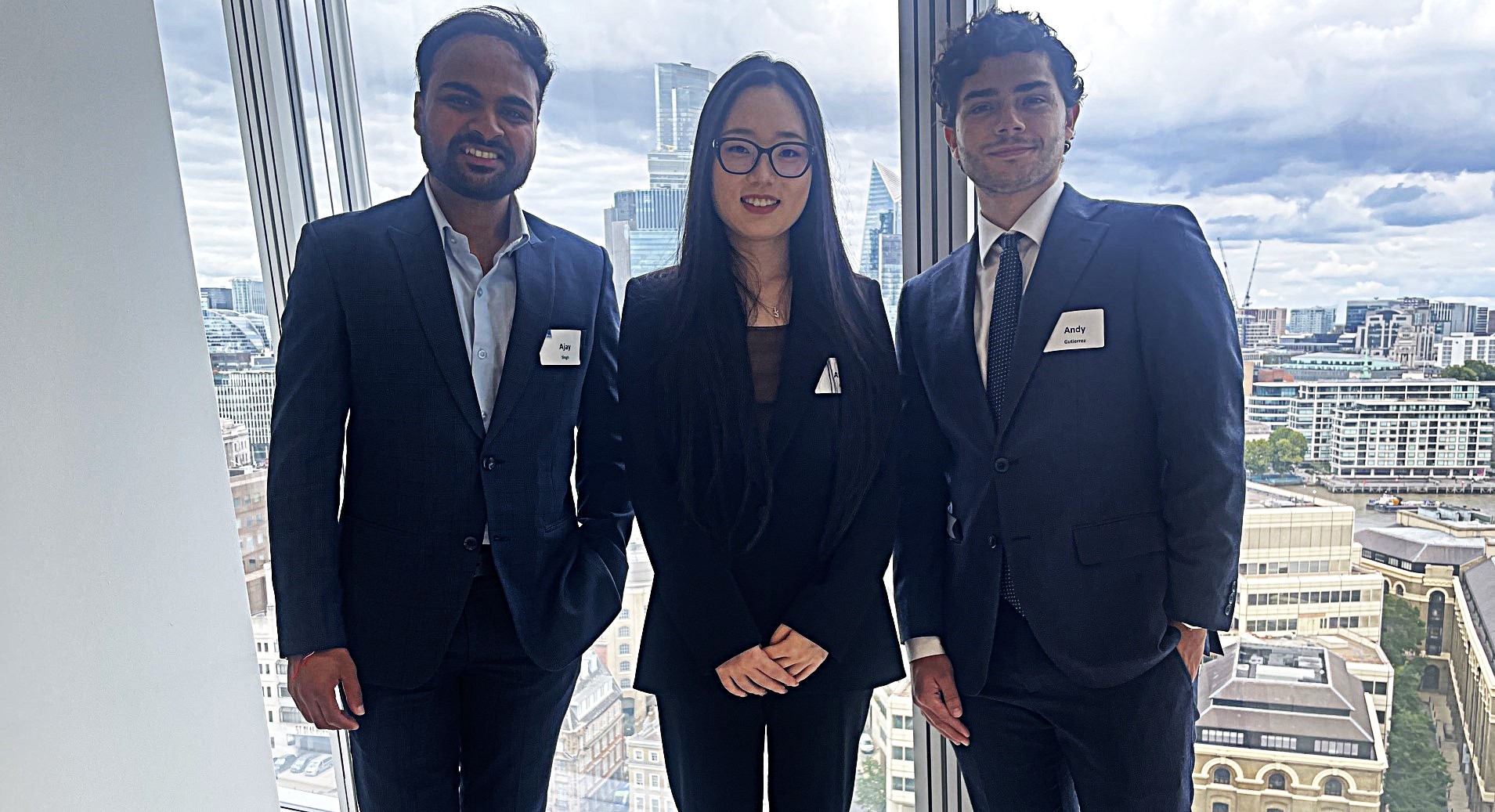
For student Andrés Gutierrez, of Costa Rica, the project with Firemind provided direct exposure to industry challenges and the chance to meet business leaders.
"The module gives a lot of exposure to employers, but the actual work was even more valuable," he said. "I conducted primary research and interviewed industry leaders and CEOs. I sent more than 600 invitations and secured seven interviews.
"Being able to speak to chief executives and senior leaders has been incredibly valuable. One of those conversations even led to discussions about a potential job opportunity at investment app Moneybox."
Luba Schoenig, Co-founder of Umushroom, a financial literacy platform helping people build wealth, asked students to design an AI-powered chatbot to answer questions from people and optimise users' experience.
She said “The students have been amazing, very creative and very proactive. To create a chatbot and present an intuitive way to onboard new users, show them key functions of the platform, help them build a portfolio and use our financial tools is a complex project.
“But they have built a very good base, which we are going to carry on and explore with them to see how we can implement their ideas. Hopefully we can find them jobs, and we would love to do it again next year.”
How do industry projects help Master's students?
Student Anish Khetani, of Harrow in North London, was part of the project set by Deloitte to create a business case for the ‘tokenisation’ of real-world assets.
Anish proposed investment in data centres with the potential to be converted into tokens that could be traded on the blockchain.
“I really enjoyed working with Deloitte and doing something in the real world,” he said. “The touchpoints we had with Deloitte were really insightful and made me think how tokenisation would work in the real world.”
For Ephie Wang, Teaching Fellow and Module Leader, the biggest success of FinTech in Practice has been the transformation in the students themselves.
"When they arrive, many are shy and lack confidence in presenting," she said. "Now they are competing to sit in the front row and asking for more time to present.
"They are telling stories with confidence, speaking from the heart, and demonstrating professional skills that will serve them throughout their careers. They have grown alongside the industry partners and are now ready for the challenges ahead."
Discover Warwick Business School's Change Makers.
 X
 Facebook
 LinkedIn
 YouTube
 Instagram
 Tiktok