

Elena Amber: Her research focuses on the gap between what people say they want and how they actually behave
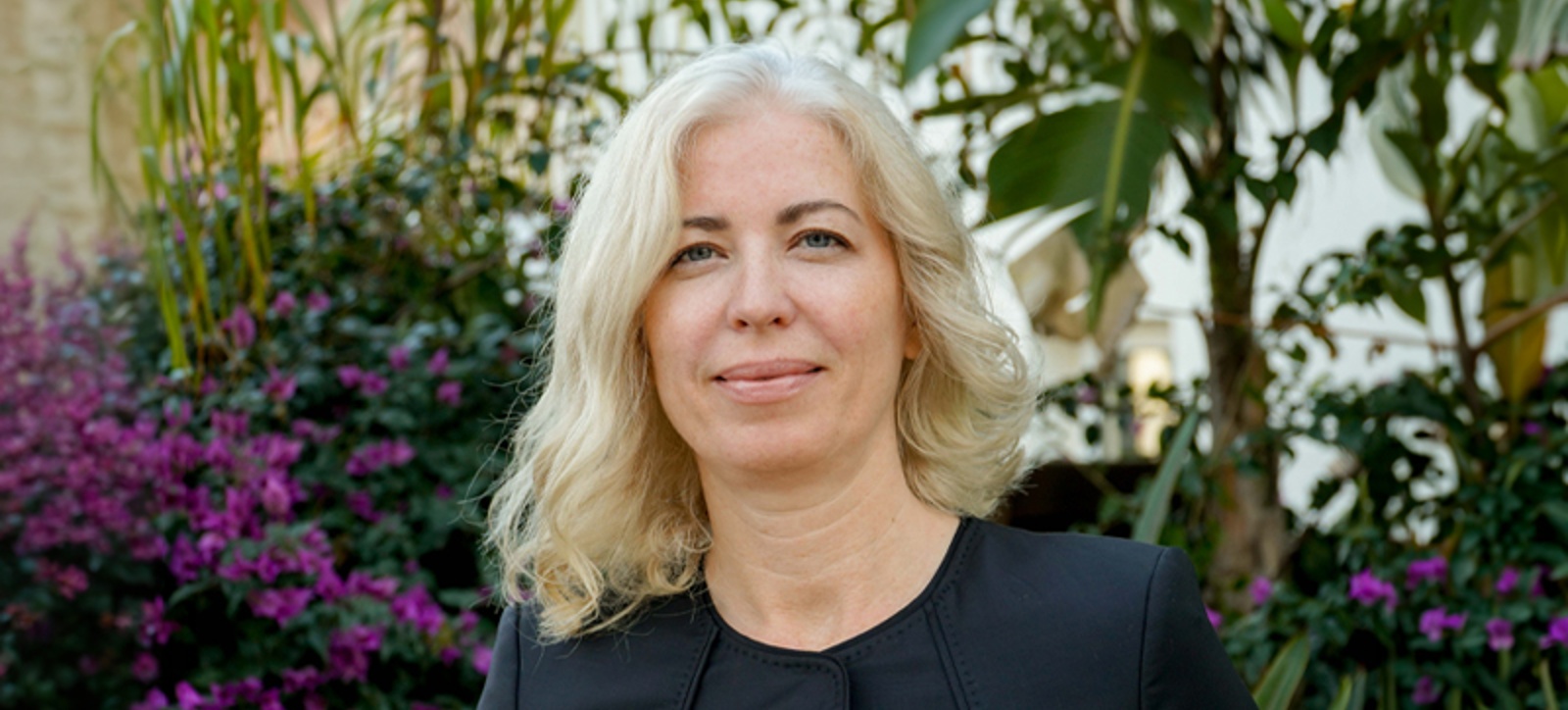
When Warwick Business School alum Elena V. Amber joins a video call from Cyprus this summer, there is little about her appearance that suggests a former corporate executive who rose to senior leadership roles across multiple markets. Dressed in black, wearing no jewellery and sitting in a plain, uncluttered room, she presents an image of deliberate simplicity. This, as it turns out, is precisely the point.
Elena believes modern economic systems increasingly monetise human cognitive and emotional vulnerabilities, transforming consumption into what she describes as a behavioural addiction.
In her view, this dynamic fuels a vicious circle of over-consumption, environmental degradation and social inequality; and her response is not only academic but personal. Minimalism, one of the 50 approaches she advocates in her award-winning book Emotional Capital for the Triple Win: 50 Innovative Ways to Lead the Consumption Revolution, has become both a philosophy and a practice.
The journey that brought her to this position began not in academia but in the business world. And the catalyst was Warwick Business School, she says.
Elena still recalls the sense of wonder she felt when she first attended the University of Warwick campus for an MBA module. Staying with a local family near the university, she ventured out before sunrise on her first morning. Captivated by the mixture of buildings, lakes and parkland, she promptly lost her bearings.
By the time she returned to her family, she had missed breakfast entirely. “It was love from the beginning,” she says. “I thought I was destined to be there.”
Modules on the Warwick MBA
The decision to apply for the Global Online MBA at WBS, a flexible part-time course which includes some residential learning at Warwick, came through a combination of ambition and circumstance. At the time, Elena was working for an international telecommunications venture, operating in an environment shaped strongly by British management culture. An English manager, himself a Warwick graduate, encouraged her to consider the school. Strong rankings and proximity to London sealed the decision.
Already an experienced marketing professional, Elena began her MBA expecting to deepen existing expertise. Instead, she found herself immersed in new ways of thinking.
Her learning in the area of strategic marketing made a particularly strong impression. “It just took me over,” she says. “I don’t think there are many business schools who apply that approach to strategic marketing, and in that depth.”
Organisational behaviour was another formative area, reflecting interests that stretched beyond commerce alone. Her academic background had been unusually broad: a first degree in biology that included psychology, followed by management studies. For Elena, understanding people was always central to understanding business.
Her dissertation on business strategy was also a milestone, developing an airline case study inspired by the pioneering low-cost and customer-relationship model of Virgin Express, which served as an example and inspiration for her work in the aviation industry at the time.
What distinguished Warwick, Elena argues, was its emphasis on the human dimension of management. Whether discussing employees, customers or emerging developments in customer relationship management, conversations repeatedly returned to people. As digital technologies began transforming communications and commerce, these discussions felt years ahead of what she was experiencing elsewhere.
Equally influential was the international nature of the MBA cohort. Students arrived from across Europe, the Middle East and Asia, creating a diversity of perspectives that reflected the increasingly globalised world of business.
The period during the MBA and after graduation in 2009 was a time of remarkable career development. Playing a core leadership role in launching a national low-cost airline, she moved on to Qatar Airways, where she developed marketing strategies for several international markets and supported the launch of the airline into two new markets: Georgia and Azerbaijan.
Afterwards, she spent more than a decade leading strategic initiatives in boardroom roles across telecommunications, aviation and venture capital-backed start-ups. As a Chief Commercial Officer and in general director positions she took on challenges such as commercial restructuring and digital sales transformation in the fields of e-commerce and financial services.
By many conventional measures, she had achieved the corporate success that ambitious MBA students aspire to secure.
Moving to Cyprus
Yet by 2012, and even though she was still very active in the corporate world, Elena found herself asking bigger questions.
Relocating to Cyprus with her family marked both a geographical and intellectual turning point. Having enjoyed a successful corporate career, she began to feel a responsibility to give something back. The challenge she chose to confront was sustainability.
“I thought, why don’t I look at one of the biggest problems?” she recalls. “And one of the biggest problems is the ecological crisis.”
The subsequent move back into education was, in some ways, a continuation of the culture she had absorbed at Warwick. Elena remains a passionate advocate of lifelong learning and remembers being inspired by older students she encountered on campus during her MBA years. Their example convinced her that education should not end with graduation.
She enrolled for doctoral research and soon discovered ecological economics, a field that brought together many strands of her career and academic interests. Biology, psychology, behavioural science, management and economics suddenly appeared as pieces of a single puzzle.
“It all became logical when you connect the puzzle,” she says.
Her research increasingly focused on the gap between what people say they want and how they actually behave. Most consumers express concern about environmental issues, yet consumption patterns often tell a different story. Exploring this contradiction led Elena towards the study of impulsive buying, behavioural psychology and the role businesses play in shaping purchasing decisions.
Connecting ideas
The conclusions she reached formed the foundation of her emerging thought leadership. Modern economies, she argues, do not simply respond to consumer demand. They actively engineer it through sophisticated marketing systems that exploit emotional vulnerabilities, stress responses and status anxieties. The result is a culture in which consumption frequently becomes a substitute for meaning, identity and wellbeing.
Her book, which won a Silver Medal in the Independent Thought Leaders category at the 2026 Axiom Business Book Awards, sets out an alternative vision.
Built on more than 200 research sources, it proposes a ‘triple win’ framework balancing nature, people and shared prosperity. Businesses, she argues, should move beyond encouraging ever-greater consumption and instead help people make informed choices that support long-term wellbeing.
For Elena, this is not anti-business. It is the next stage of business leadership – a new era in which companies and consumers stand alongside each other, building a better world together.
That conviction can be traced directly back to Warwick. The MBA gave her not only technical expertise and career acceleration, but also consolidated something less tangible: the habit of questioning assumptions and the confidence to connect ideas across disciplines.
The executive who once used business education to help build fast-growing enterprises is now using it to challenge some of the assumptions underpinning modern capitalism. Two decades after getting lost on Warwick’s campus, Elena is still following a path of discovery.
Find out more about Warwick Business School’s MBA programmes.
Discover the School’s Change Makers.
 X
X Facebook
 LinkedIn
 YouTube
 Instagram
 Tiktok