

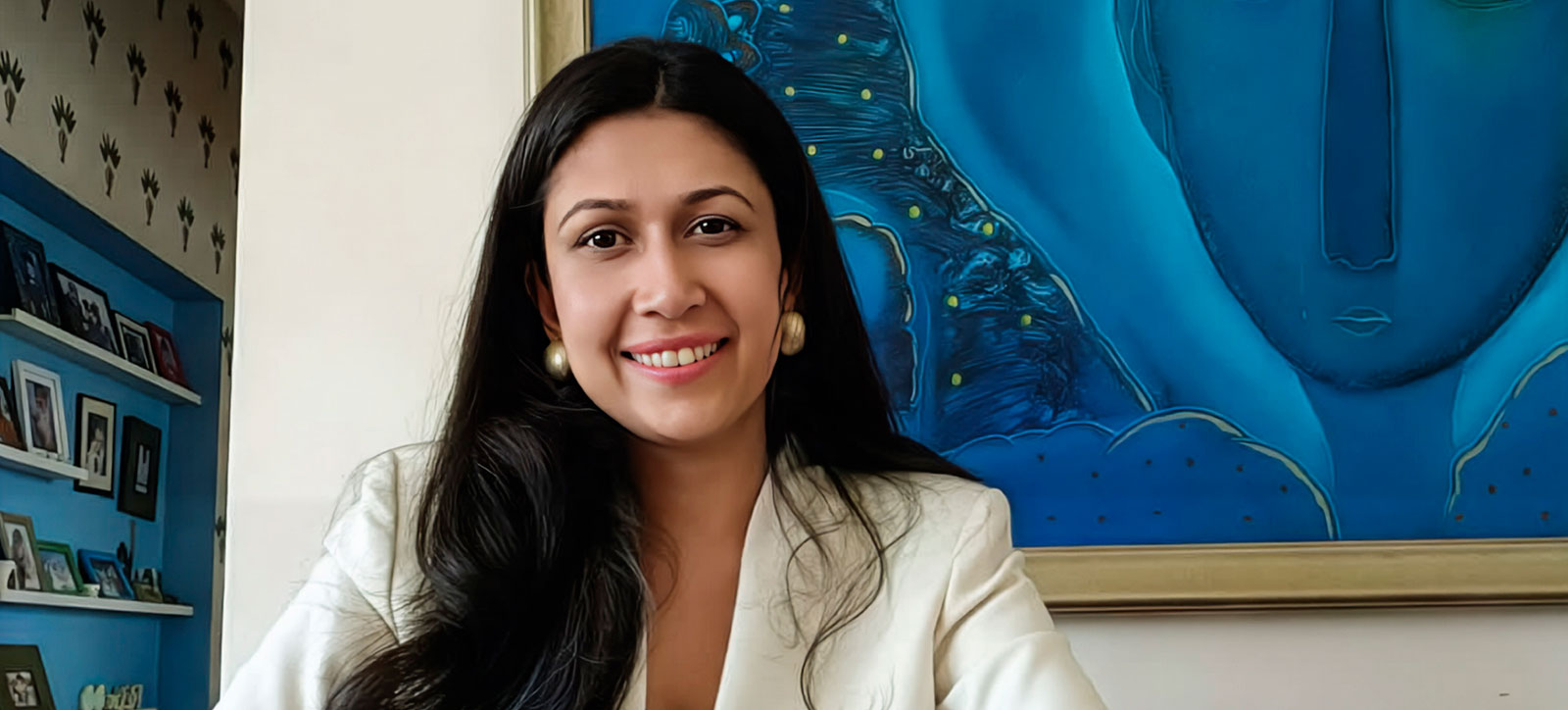
BSc graduate: Ridhi Doongursee is co-founder of India's first fintech platform designed specifically for women
When Ridhi Doongursee arrived at the University of Warwick in 2000, fintech was not yet part of the business lexicon. Two decades later, the Warwick alum has become one of India’s leading fintech entrepreneurs, co-founding Lxme, the country’s first women-focused financial platform combining payments, investing and financial education.
Ridhi graduated in 2003 with a BSc Computer and Business Studies, a joint honours degree that split her time between Warwick’s computer science department and Warwick Business School. The combination of technology and business would prove formative.
“Warwick shaped who I am,” she says. “It opened up a whole new world.”
Today, her career reflects the increasingly close relationship between technology and finance that WBS has helped to champion. The School is at the forefront of fintech education through its dedicated MSc Financial Technology programme, while the Gillmore Centre for Financial Technology has established itself as a leading hub for research into the digital transformation of financial services.
For Ridhi, the seeds were planted much earlier. Growing up in “a very protected family of two girls” in Mumbai, she became fascinated by technology as a teenager, seeing in the first clunky personal computers a powerful tool for solving problems and expanding opportunities.
The love of tech
This led her to strike out on her own to pursue an international university experience. Stumbling across Warwick’s embryonic website on her family computer, she was determined to make her own way. In India’s conservative society at that time, she never wanted her parents to feel they were “missing out by not having a son”.
So, following a foundation year in Stratford-upon-Avon, she ended up at Warwick, and here she was able to really kickstart her love of tech.
While studying, Ridhi joined UBS on a summer internship, which turned into a full-time job in systems implementation on completing her degree.
Afterwards, she returned to India and applied her technical skills to modernise her family’s business before embarking on an exciting entrepreneurial journey. She founded Credit Monk, a business credit-rating platform, followed by Industricals, India’s first B2B distribution app for electrical and industrial products.
But it was her next venture that tackled a much larger challenge.
In 2020, Ridhi joined financial services veteran Priti Gupta to build Lxme, a fintech platform designed specifically for women. The company addresses a significant gap in India’s financial ecosystem, where women remain underrepresented as investors despite growing economic participation.
More than a payments and investment app, Lxme seeks to build financial confidence through education. The platform offers financial literacy programmes, investment guidance and community-led learning, alongside tools that help women save, invest and plan for major life events.
“We interviewed thousands of women. We understood their needs, fears and socio-economic conditioning, and then built a platform around that,” says Ridhi.
A central lesson was the importance of trust. “If there’s an app where you can buy crypto or shares, men will just go and do it. They’ll put in £100, build trust, and start investing more,” says the Warwick alum.
“Women need to build trust first. They won’t put a single dollar into something they don’t trust. So we built an eco-system where there’s literacy and fun – because we’ve gamified things – and that builds comfort, trust and confidence.
“Only once that trust is there, do we feel we can ask them to transact. So the ethos, emotional support and curation of products is all built around what women want and need.”
The company has growth in its sights, and it is looking to tap into a significant but overlooked market. “There are 20 million Indian women who we want to help take charge of their money and build their financial safety nets,” she says.
Ridhi's ultimate objective is for Lxme – pronounced Lakshmi after the Hindu goddess for prosperity – to become one of the biggest women and family apps in the country. It is a goal that reflects both the technical mindset she developed as a Warwick student and the convergence of finance and technology that now defines much of the global economy.
For WBS alumni following similar paths, her story also highlights the growing relevance of fintech education. As universities and business schools expand their focus on the sector, WBS continues to play a leading role through both teaching and research, helping prepare the next generation of entrepreneurs operating at the intersection of technology and financial services.
For Ridhi, meanwhile, the mission remains simple: women can use technology to create opportunity. “You can invest immediately and start investing with really small amounts,” she says.
“Why? Because compounding is real and it is the eighth wonder of the world.”
The tools may have evolved dramatically since the days of the dial-up internet in Mumbai in the 1990s, but the principle has not changed. Technology, she says, remains one of the most powerful enablers of financial independence.
Find out more about the BSc Computer Science with Business Studies.
Discover Warwick Business School’s Change Makers.
 X
X Facebook
 LinkedIn
 YouTube
 Instagram
 Tiktok