


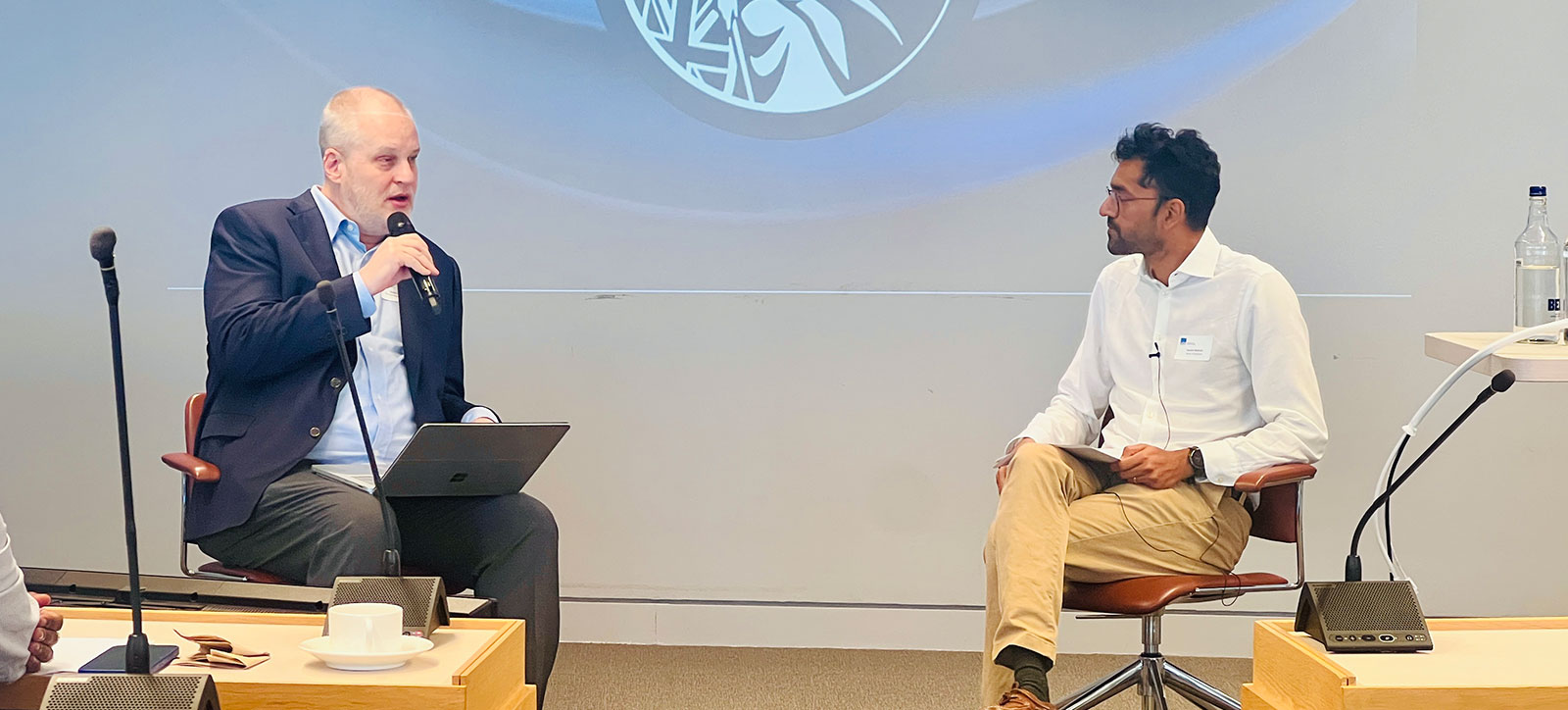
Future finance: WBS Professor David Skeie in conversation with the Bank of England's Kushal Balluck
The Gillmore Centre for Financial Technology welcomed academics, policymakers and practitioners from around the world at WBS London at The Shard for its fifth annual Academic Conference on Decentralised Finance (DeFi) and Digital Currencies.
The two-day conference explored how questions once associated mainly with crypto and experimental financial technologies are increasingly becoming questions of mainstream financial-market design.
Attention is shifting from whether technologies such as tokenisation, stablecoins and decentralised finance can work to where they create economic value, how they interact with existing financial institutions and infrastructure, and what new risks or policy questions they may create.
Those questions provided the backdrop to two days of research and discussion spanning digital currencies and payments, automated market makers, blockchain and market design, tokenised assets and the development of new financial-market infrastructure.
Participants included academics from Warwick Business School and universities such as Duke, Columbia and McGill, alongside researchers and policy specialists working at organisations including the Bank for International Settlements, Bank of Canada, Banque de France and the Bank of England.
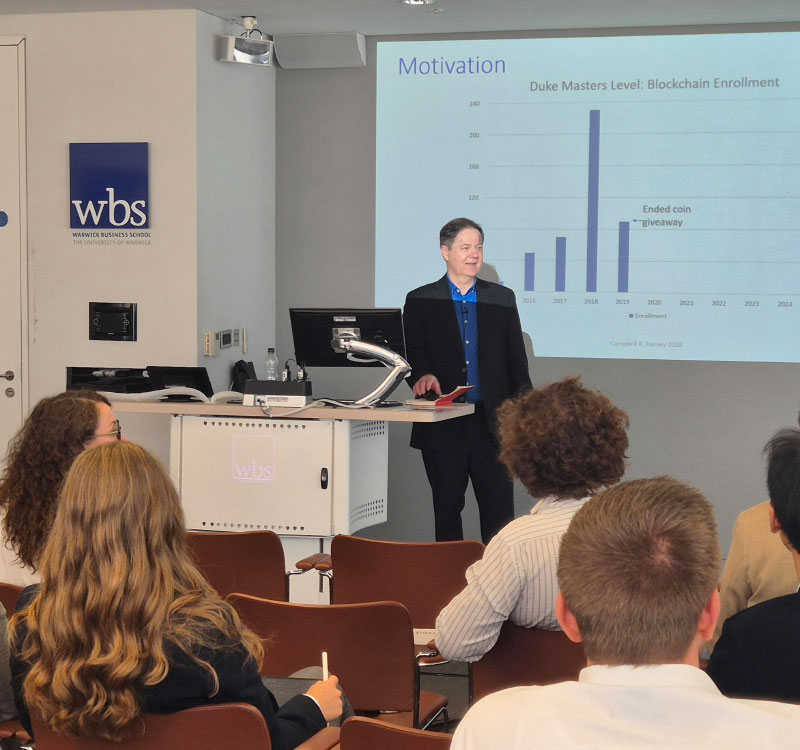
Campbell Harvey: how crypto lost its way – and how tokenisation could bring it back
The conference's academic keynote speech was delivered by Professor Campbell R. Harvey, of Duke University's Fuqua School of Business, a leading academic researcher in cryptocurrency, blockchain and decentralised finance.
Professor Harvey traced the evolution of crypto and DeFi from Satoshi Nakamoto's vision for a new financial system following the 2008 financial crisis to the emergence of crypto and decentralised finance as established areas of academic research.
He also reflected on his own efforts to establish crypto and DeFi as serious subjects of academic study at Duke University, including the creation of the Innovation and Cryptoventures course in 2015, which has since become one of the business school's most popular offerings.
Professor Harvey outlined some of the problems in traditional finance that crypto and DeFi were originally intended to address, including inefficiency, limited access, opacity, centralised control and a lack of interoperability. But he argued that the sector subsequently lost sight of that original purpose, becoming heavily driven by speculation.
For Professor Harvey, tokenisation and stablecoins could represent a new turning point. These technologies, he argued, could help reconnect digital finance with the original objectives of DeFi, not by replacing traditional financial institutions, but by working alongside them and improving how financial markets operate.
The result could be a hybrid financial system combining elements of traditional finance and decentralised technologies.
From technical possibility to market design
Opening the conference, Professor Ram Gopal, Academic Director of the Gillmore Centre for Financial Technology, described the Centre's approach of bringing together academic research, policy and practice.
"What was once niche is now becoming mainstream, and it's the collaborative efforts across academia, industry and policy that drive the change and create tangible impact," he said.
"This is the core operating principle of the Gillmore Centre. We embrace multi-disciplinarity and co-creating with policy and practice, while leveraging technology to drive innovation."
That shift was reflected across the academic programme. Many of the papers focused less on demonstrating that new financial technologies are technically possible than on understanding their economic consequences and design trade-offs.
Research examined how new arrangements can affect liquidity, market quality, incentives and risk, including the interaction between stablecoins and safe-asset markets, payment sovereignty, the use of automated market makers in foreign exchange, blockchain market design, and the economics of tokenising assets such as real estate and money-market funds.
David Skeie, Professor of Finance at Warwick Business School and co-organiser of the conference, said the programme reflected how quickly questions surrounding digital finance are changing.
"What strikes me about this year's programme is how quickly questions that only a few years ago were treated as relatively specialised issues in crypto and decentralised finance have become mainstream questions in finance," he said.
"Our objective at the Gillmore Centre is not to advocate for particular technologies. It is to understand where they can make financial markets work better, where they may create new problems, and how policy and regulation should respond."
That evidence-based approach was central to the conference, with researchers examining not only the potential benefits of emerging technologies but also the implications for market structure, liquidity, risk and regulation.
Tokenisation moves from experiment to regulated live activity
The conference also considered how these questions are playing out in financial-market infrastructure and policy.
Kushal Balluck, Senior Manager for Post Trade Innovation at the Bank of England, discussed developments in tokenised wholesale finance, including the Digital Securities Sandbox (DSS), operated jointly by the Bank of England and Financial Conduct Authority.
The DSS allows firms to undertake regulated live activity in the issuance, trading and settlement of digital securities. Mr Balluck stressed that the "sandbox" has sometimes been misunderstood: it is not simply a test environment, but involves real securities and live market activity.
He also discussed the Bank's work on RTGS (Real-Time Gross Settlement) synchronisation, which supports atomic settlement in central bank money: allowing the controlled movement of funds between RTGS accounts, conditional upon movements of assets recorded on external ledgers.
Mr Balluck noted interoperability as a challenge for market participants in the adoption of tokenisation, and the risk that multiple platforms could develop into separate 'digital walled gardens', fragmenting liquidity and making it harder for assets and money to move efficiently between infrastructures.
Taken together, these parts of his remarks connect with wider market-design questions running through the conference: not simply whether new financial technologies can work, but how they connect to existing systems of money and settlement, and what happens to liquidity and market functioning when activity is distributed across different infrastructures.
What does tokenised finance mean for the future of money?
The conference also examined the development of programmable money and its potential role in wholesale financial markets.
A securities transaction typically involves two elements: the transfer of the asset and the transfer of cash. Programmable money could allow the movement of money to be automatically co-ordinated with the transfer of an asset when specified conditions, rules or events have been met. This could enable more efficient forms of programmable settlement.
The Bank of England’s Synchronisation lab is currently testing with private sector participants how programmable settlement could function using RTGS. Other forms of money such as stablecoins and tokenised deposits could also offer programmable settlement. The discussion reflects a wider question facing financial markets: how can new forms of digital money and tokenised assets be integrated with existing financial infrastructure while maintaining stability, liquidity and trust?
From whether it will happen to what it can achieve
Across the two-day programme, the conference highlighted how quickly digital finance has moved from a specialist area of research towards questions that sit within mainstream financial-market design.
Closing the conference, co-organiser Professor Roman Kozhan reflected on the breadth of the programme, which spanned stablecoins, securities, automated market makers, blockchain economics and the growth of tokenised assets.
Looking ahead, Professor Kozhan suggested that the debate is increasingly moving beyond whether these technologies will become established towards whether they solve meaningful financial problems.
As the Gillmore Centre marks five years of bringing together researchers, policymakers and practitioners working in digital finance, the conference demonstrated how the debate has moved beyond whether these technologies will become part of the financial system. Increasingly, the focus is on what they can achieve, how they should be designed and integrated, and whether they can deliver meaningful improvements to the way financial markets operate.
Further reading:
Regulatory transition could be 'impossible' for some stablecoins
What does the bitcoin inflation rate really mean?
AI bias: What can the Claude chatbot leak teach investors?
Why AI could transform peer-to-peer lending for investors
Learn more about fintech on the MSc Financial Technology.
Discover more about fintech. Receive our Core Insights newsletter via email or LinkedIn.
 X
 Facebook
 LinkedIn
 YouTube
 Instagram
 Tiktok