



Innovator: Eraj Rostaqi outside The Shard who is founder of Velominati AI, a financial and regulatory platform
WBS Founders Hub Co-Lead Simon Barnes believes the start-up programme at WBS London is an example of how universities can kick-start the UK economy out of its low-growth malaise.
UK GDP grew by 0.2 per cent in September, following no growth in August, and Professor Barnes believes training bright young minds to be entrepreneurs can help revitalise the country’s economy.
As Assistant Dean (Ventures), Professor Barnes believes the first year of the Warwick Enterprise Start-up Programme has shown the potential for training and guiding graduates into building a business.
“British universities produce outstanding graduates,” says Professor Barnes. “Can’t we help them grow great businesses?
“Instead of jobseekers we can develop job creators, whose start-ups can help grow the economy.”
Based at WBS London on the 17th floor of The Shard, the Founders Hub offers start-ups workspace, specialist workshops, and access to 45 mentors, many drawn from the University of Warwick’s alumni network.
In its first 12-month Warwick Enterprise Start-up Programme, which is open to all University of Warwick students or graduates, the Hub has supported more than 20 young companies.
“We think this is a really overlooked segment of the entrepreneurial landscape,” says Professor Barnes, who has 25 years of experience in the venture capital industry in the UK, EU and US. “The overall goal of the programme is to kick-start this, mobilising the student and graduate start-up community. And we are placing founders close to London’s investors, professional advisers, and corporate customers.
“It’s working - we’re getting an increasing quality and number of start-ups joining the programme. What we’re starting to see in the Founders Hub is a buzz and an energy between the founders as they trade ideas, share stories and help each other.”

The programme, a collaboration between Warwick Business School and Warwick Enterprise, accepts two cohorts each year. Applicants pass through a competitive pitching process before receiving access to 12 months of support and workshops covering areas such as finance, intellectual property, human resources and presenting to investors.
WBS Founders Hub Co-Lead Alexander McLeod said: “We've been delighted by what the first cohort has achieved. Seeing founders go from early-stage ideas to generating revenue and attracting investment shows the value of giving talented students and graduates the right environment, networks and support.
“The ambition is not simply to help people launch businesses, but to help them build ventures that can make a lasting economic and social impact.”
Velominati AI, a financial and regulatory platform; Bee Skilled, which provides digital learning for healthcare professionals; and Merra, an AI hiring portal, have all become revenue-generating in their first year.
Sanjay Saha, founder of Bee Skilled, has concentrated his marketing and sales in Africa and other emerging markets.
It hosts about 8,000 health professionals, offering career credentials, masterclasses and peer-learning programmes priced between $40 and $150. Bee Skilled also designs and hosts online courses for institutions and advises organisations seeking accreditation for their programmes.
The company is profitable, with Sanjay, who set up the business in India and is currently studying an Executive MBA at WBS, joining the programme to establish a British base and to seek investment.
“With the help of the advisers, I have been able to refine our business model and financial structures, create valuation models and discuss the risks associated with the business,” he says.
Sanjay made his first pitch at an investor forum organised by the programme, with Bee Skilled seeking £400,000 in pre-seed funding to expand into priority African markets and increase its membership to 200,000 within three years.
How WBS London helps entrepreneurs attract investment
Meanwhile, Michelle Sartorio, an MBA student and founder of sustainable personal care company Auê Natural, has raised £188,000 from investors shortly after completing her year on the programme.
Another participant, Velominati AI, shows how The Shard’s proximity to the City can help. Founded by Eraj Rostaqi, it uses AI to collect and update financial and regulatory information, helping financial institutions manage compliance and reduce manual data work.
Velominati was already generating sufficient revenue to operate without outside investment when it joined. The priority was to build a stronger organisation around the product and prepare for expansion.
“The workshops have strengthened our strategic planning, operational frameworks and commercial readiness,” says Eraj, who graduated with an MBA in 2021. “They’ve pushed us to professionalise our processes, challenge our assumptions and close gaps we might not otherwise have prioritised.
“Being based at WBS London in The Shard has also been a real asset. We work alongside other founders facing similar challenges, and we can host investors, partners and customers in a setting that gives a small company real credibility.
“We've been generating revenue since launch, and it has been enough to fund the business without outside investment so far. However, we've made the strategic decision to raise funds in the near future. We believe we're now at a stage with real potential for rapid growth, and we want to seize that opportunity.”
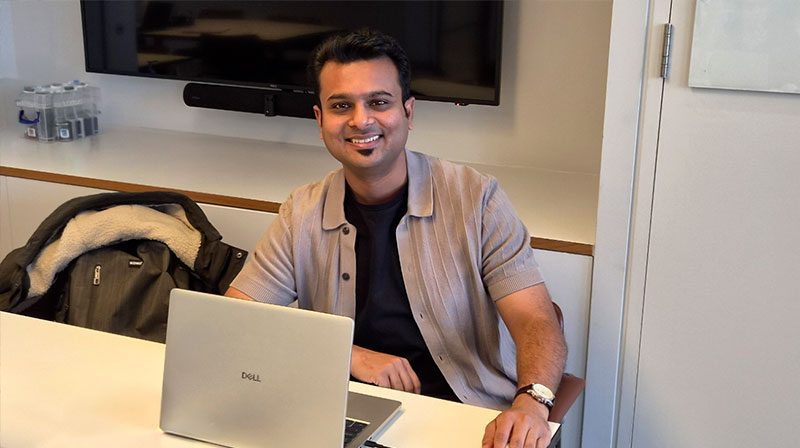
Professor Barnes wants more graduates to consider working for start-ups, where small teams can provide experience across several business functions.
“I’ve been saying to students: go and do a start-up or join one,” says Professor Barnes, who recently authored Building Value: The Business of Venture Capital.
“The start-up may not become a massive success, but working in a small team gives you broad, practical experience, and that can be incredibly valuable in any future role. And maybe it is a massive success – it is a win-win situation.”
Professor Barnes is now exploring scholarships that would cover living expenses so graduates can spend a year focused on building businesses at The Shard.
“I know there’s the financial problem of needing a salary, but that’s why we are looking at the idea of a scholarship that would support people over that first difficult year,” says Professor Barnes.
“We have already had 48 start-ups pitching to join the next cohort for the programme, and there are some real quality businesses in there.
“This is a very exciting opportunity for WBS. We want to be at the centre of what I think is a growing national conversation about the potential for student and graduate start-ups.
“Student and graduate founders could be a really important engine for the UK economy.”
Discover Warwick Business School's Change Makers.
 X
 Facebook
 LinkedIn
 YouTube
 Instagram
 Tiktok