


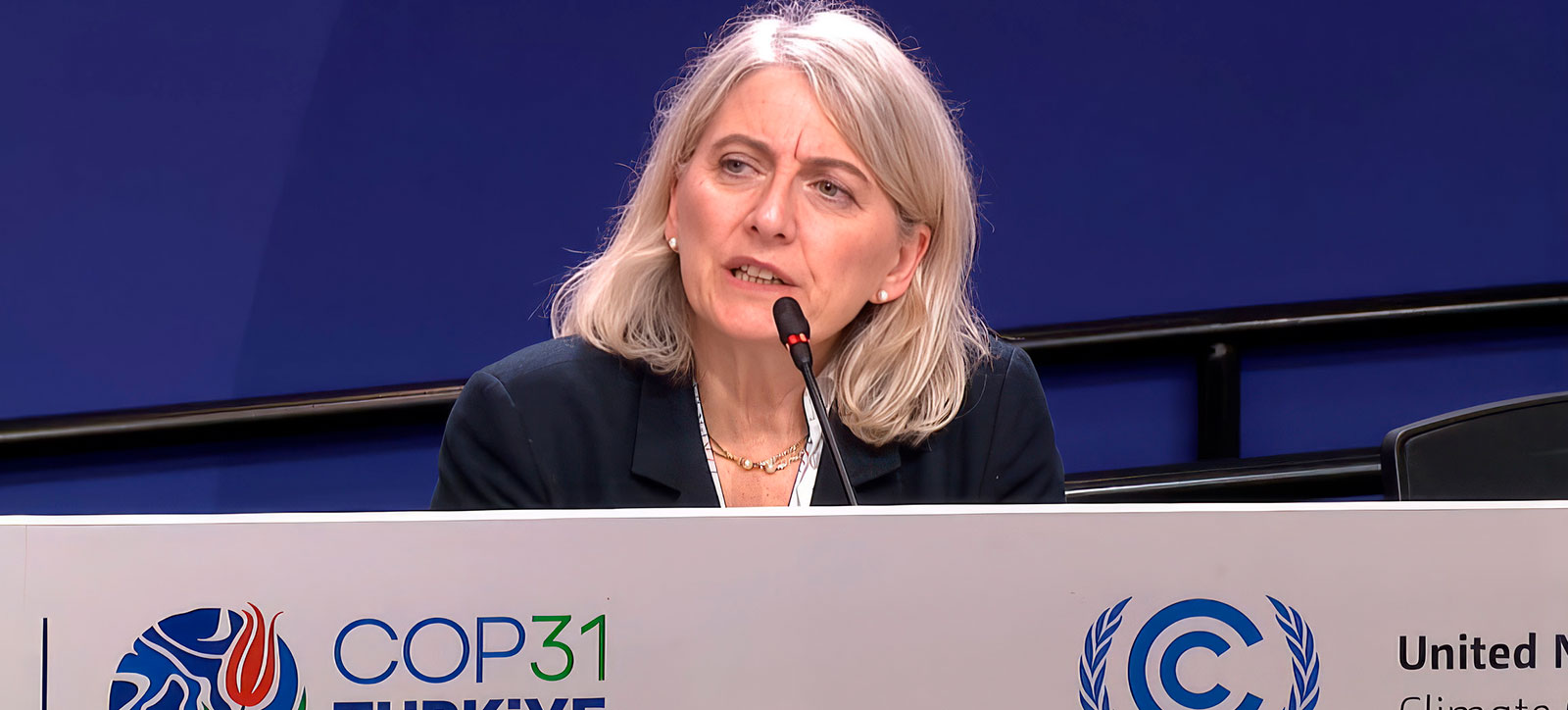
Community power: Professor Battisti highlighted the importance of locally led renewable energy at COP31
While COP31 ended without a new agreement to tackle climate change, a WBS academic took a leading role at the summit, championing an approach to Africa's clean energy transition that puts local economic development at its centre.
Giuliana Battisti, Professor of the Economics of Innovation at Warwick Business School, spoke at four events and a United Nations press conference during the forum in Antalya, Türkiye.
Speaking on a UN panel for Zero Waste Day, streamed live on UN TV, and chairing a Finance Day roundtable at the Namibia Pavilion, Professor Battisti, argued that renewable energy investment must do more than provide infrastructure. It must create local economic opportunities, strengthen industrial capability and ensure communities share in the benefits.
Half a continent in the dark
More than 560 million people in sub-Saharan Africa still lack access to electricity, according to the International Energy Agency’s latest figures. For many, this is not a question of coping with an occasional power cut. It means living without electricity altogether.
On the UN panel, Professor Battisti brought the human consequences into sharp focus.
“We have communities that get up in the morning with the sunrise, go to bed when the sun sets,” she said.
“Think of the inequality, the social justice. We are upset if for a second there is a blackout. Think about living in communities that don’t know what electricity is.”
Electrification is an urgent priority. But, she argued, the rush to connect communities must not come at the expense of thinking about what happens next.
As microgrids and solar panels are installed, who will maintain them? What happens when equipment reaches the end of its life? Who will repair, repurpose or recycle it?
Get that wrong, and communities gaining access to electricity could be left with a different problem: obsolete equipment, mounting waste and a market that never becomes self-sustaining.
Financing a just energy transition
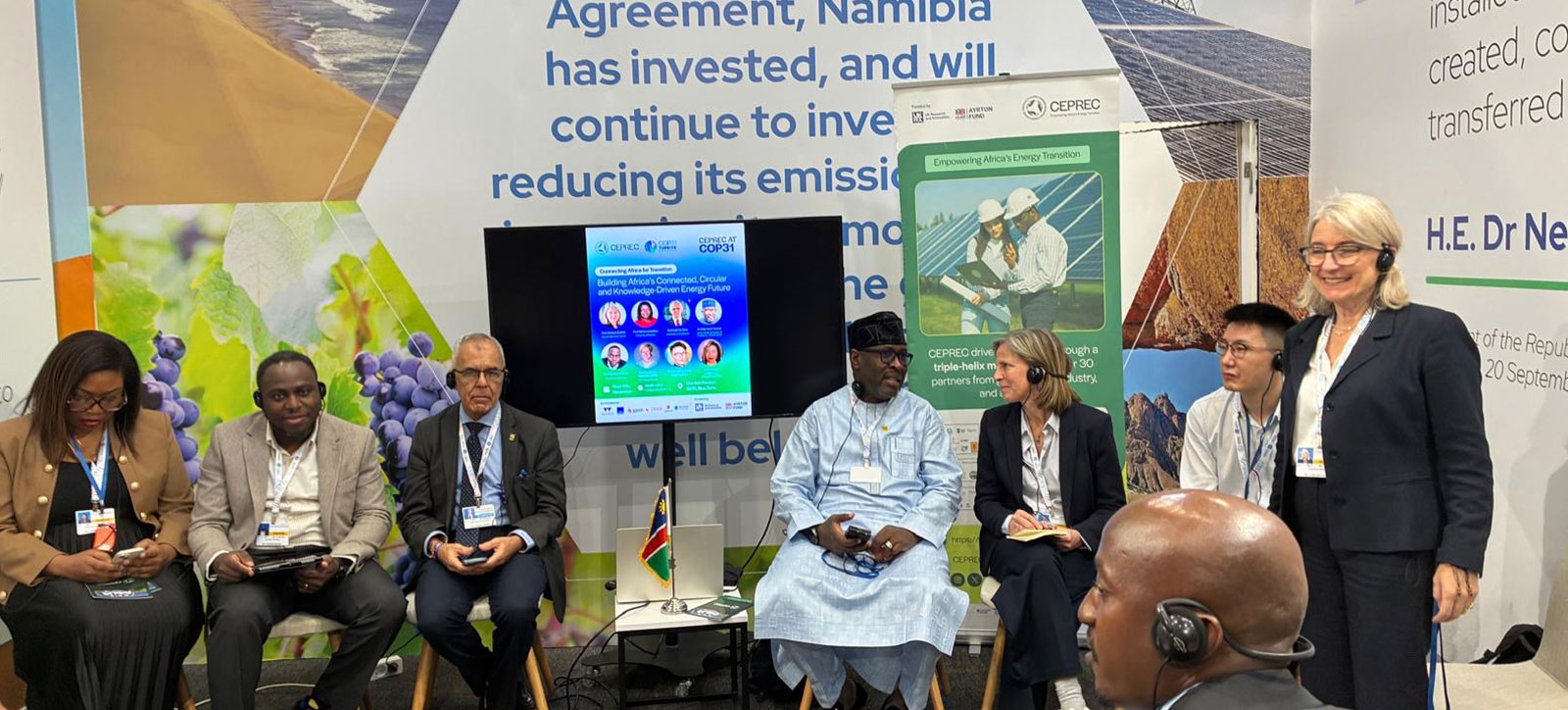
These questions also shaped Professor Battisti’s second COP31 engagement: an international roundtable she chaired at the Namibia Pavilion, titled Financing Just Energy Transitions: Aligning Climate, Investment and Development Priorities.
Bringing together expertise across finance, law, economics, policy and development, the discussion examined how investment and climate finance could better support African countries’ ambitions. Namibia provided an important context, with its plans spanning renewable electricity, transmission and storage, green hydrogen and industrial development. Its National Energy Compact connects investment with affordability, electrification and support for local businesses.
The challenge is to ensure that climate finance does more than fund renewable infrastructure. It must also support employment, affordable energy and the businesses and capabilities that enable communities to benefit from the transition.
Why catapulting technology doesn’t work
This is central to Professor Battisti’s research into innovation, technology adoption and industrial policy. She co-leads the University of Warwick’s Sustainability Spotlight research initiative and is Deputy Director of CEPREC, a £3.5 million UKRI-funded Pan-African research centre working to advance sustainable, circular energy solutions.
Most of the conversation about the energy transition is about how much finance can be mobilised. CEPREC’s work is about how technology is absorbed.
“Catapulting technology doesn’t do any good,” Professor Battisti explained on the UN panel. “Technology needs to be embedded within systems, and to do that we need to understand how they are used locally and what we can do with local people to overcome a number of barriers: familiarity, prejudice, scepticism, superstition.”
A technology that works in one country cannot simply be transplanted into another and expected to succeed. It needs to make sense within local economies, skills, cultures and ways of working.
Professor Battisti also took this message to the Global Localisation Forum at COP31, where discussions focused on giving communities greater influence over climate and development decisions.
The event highlighted the importance of local knowledge and leadership in shaping successful energy transitions, reinforcing Professor Battisti's argument that communities should help design and govern clean energy projects rather than simply receive them.
Building capability across six countries
CEPREC works across South Africa, Namibia, Nigeria, Kenya, Sierra Leone and Rwanda. Its triple-helix approach brings together academia, industry and government to turn knowledge into real-world impact. The centre supports 14 PhD students and 26 associate and academic leads across six African countries and hosts regular webinars that connect researchers, policymakers and businesses.
Its work follows three interconnected priorities: building local production, using energy to enable wider economic activity, and creating the policy conditions for investment and innovation.
In Nigeria, for example, existing cable-manufacturing capability offers an opportunity to strengthen local supply chains rather than rely entirely on imported equipment. Creating employment also generates a wider economic effect, Professor Battisti explained:
“Once you create employment, you start this multiplier effect that allows people to spend and buy and then have more ability to use the technology.”
Access to electricity can also transform what communities are able to do. For farmers, it can mean irrigating land, increasing production and growing a business. But inconsistent or conflicting policies can deter the investment needed to make these opportunities real. CEPREC works with governments and organisations including the UN, to help address those barriers.
Circularity runs through the work. “We don’t want to lock in communities into obsolete technology cascaded from other countries; we want them to develop the understanding of how technology is made,” Professor Battisti said.
The same principle featured in a COP31 session on sustaining renewable energy investments with the African Development Bank and the African Circular Economy Alliance, where Professor Battisti argued that financial instruments for circular approaches can help ensure technologies remain economically and environmentally sustainable long after deployment, while creating local jobs, skills and business opportunities.
Global impact through shared knowledge
Professor Battisti teaches the economics of the business environment on WBS MBA programmes, while her research connects with the School’s MSc Business with Sustainability. CEPREC also develops the next generation of researchers, equipping PhD students to work with businesses, communities and policymakers.
It demonstrates global impact, too: research shaped by African priorities, with expertise and knowledge shared in both directions.
“Africa, I have no doubt, is going to be next in climbing up the ladder of technology development,” Professor Battisti told the COP31 discussion. “Networks are crucial, not just North–South, but within Africa as well, because the centres of excellence have to be connected.”
Ultimately, the value of clean energy is not created at the point of installation. It is created, or lost, over the technology’s entire lifetime: in the jobs it generates, the businesses it supports, the communities it empowers and the environmental legacy it leaves behind.
For the households still waiting for electricity, getting that transition right matters enormously. The challenge is not simply to deliver technology, but to build the local capability to make it last.
Giuliana Battisti is Professor of the Economics of Innovation. She researches the generation, uptake and impact of innovations and new technologies; industrial and innovation policy; and applied industrial organisation. Giuliana teaches Economics of the Business Environment on the Global Online MBA and Executive MBA.
Giuliana also co-leads the University of Warwick's Sustainability Spotlight research initiative and is the Deputy Director of CEPREC, the UKRI-funded initiative for the uptake of circular renewable technologies to empower energy generation and equitable transition in Sub-Saharan countries.
Further reading:
Three ways to nudge customers to buy green products
Can we be nudged to act on climate change?
How multinationals can avoid supply chain scandals
'The transition is already happening': Lessons from COP30
Discover more about sustainability and leadership. Receive our Core Insights newsletter via email or LinkedIn.
Choose Warwick Business School as a preferred source of trusted insights in your Google searches.
 X
 Facebook
 LinkedIn
 YouTube
 Instagram
 Tiktok