
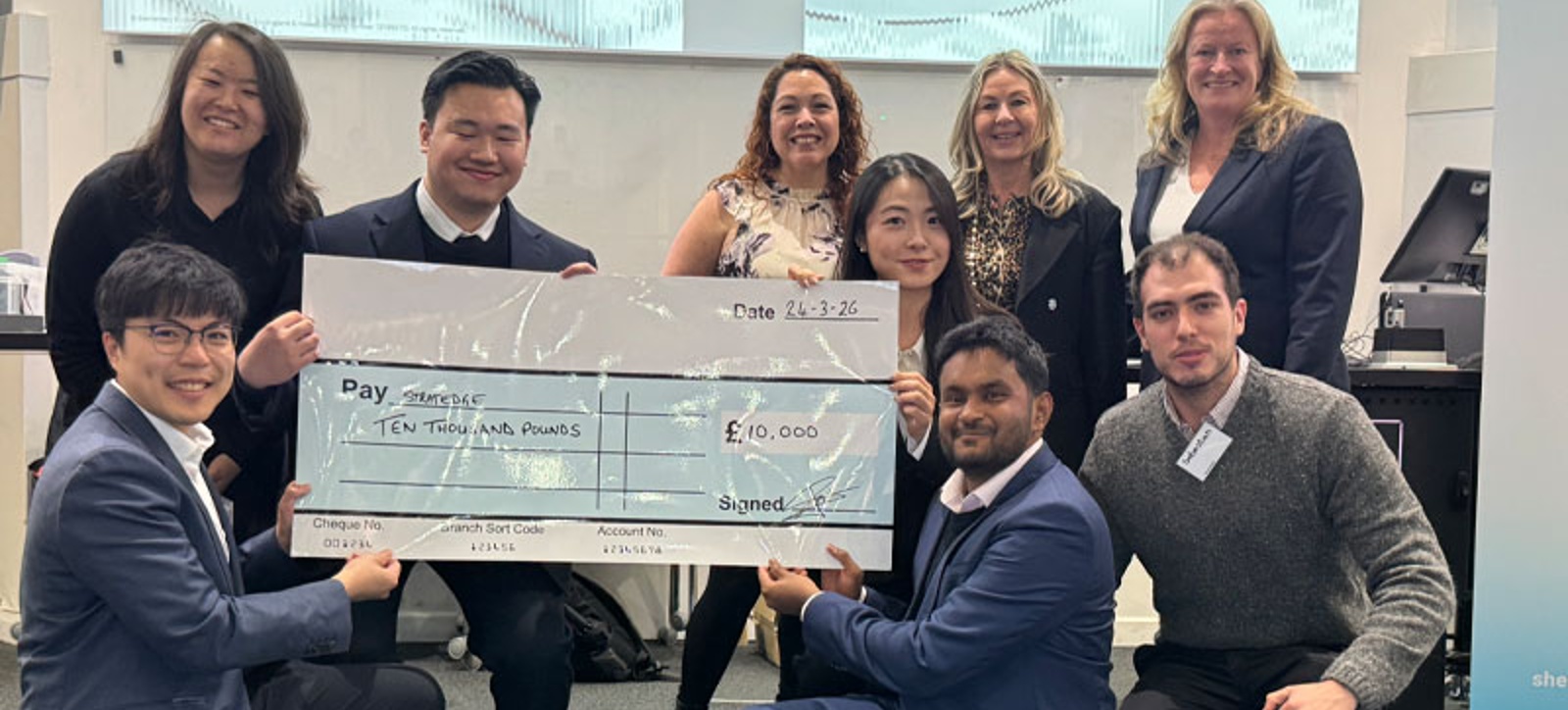
Reality cheque: It may have been a simulation but the money prize awarded by sherloc and won by the Master's students who made up the Stratedge team was very real
A group of Master’s students have won a cheque for £10,000 after winning an intensive business hackathon designed to test how future leaders respond to real-world corporate crises.
The event, organised by sherloc, an AI-powered satnav for small and medium-sized enterprises (SMEs), brought together dozens of students at Warwick Business School’s Gillmore Centre for Financial Technology to tackle a sequence of escalating challenges facing a synthetic defence-technology start-up, Atlas Robotics UK.
The winning team, Stratedge – comprised mainly of MSc Business Analytics students – outperformed rival groups in a competition that blended financial modelling, strategic decision-making and leadership under pressure. A second WBS team, Boardroom Detectives, secured the £5,000 runner-up prize.
The hackathon required participants to use sherloc’s 'financial brain', which can combine HR, sales, operations and finance inputs to produce a unified, real-time financial truth, to steer the fictional SME through four scenarios: supply-chain disruption, a cyber-attack, strategic replanning and an energy-price shock.
Using sherloc's ability to translate strategy into numbers, students were asked to make rapid decisions on cashflow, funding options and operational strategy, updating their financial models in real time.
A crash course in crisis leadership
For Stratedge, the experience was as much about team dynamics as financial acumen. Frankie Lai, a financial planning and analysis professional studying MSc Business Analytics, said the simulation offered a rare opportunity to apply technical skills in a high-pressure environment.
“We spent forty-eight hours running a struggling defence tech start-up through four crises. The learning was more valuable than the £10k prize,” Frankie said.
“The dynamics of an eight-month 'runway' SME are completely different from FTSE 100 planning. Every decision matters immediately.”
The team’s early performance was far from smooth but by the final scenario, the group had developed a disciplined decision-making framework. “Being thrown into these real-life business challenges, we learnt how to think quickly and adapt to the different situations,” said Frankie.
“We came up with solutions that would be really helpful for any future job interviews or future working situations.”
Other team members also emphasised the importance of the learning opportunity. “We learnt a lot about how to act during a business crisis,” said MSc Business Analytics student Minji Kim.
She also praised the opportunity to work with sherloc’s forecasting tools: “It’s not an opportunity you get every day to really look at the numbers, see the forecasts, and really consider all the possibilities.”
Strength in diversity
Boardroom Detectives, the second-place team, bought together students from the MSc Management and MSc Business Analytics programmes at WBS plus the MSc International Trade, Strategy & Operations course at WMG. They described the hackathon as both demanding and energising.
“It was a highly pressure-building exercise but this helped us come up with solutions,” said MSc Management student Shreya Bhat.
The team members’ diversity was a strength, MSc Business Analytics student Jaskirat Singh added, noting that their combined backgrounds in technology and finance shaped their approach to the case study.
Fellow Business Analytics student Sahil Bhure noted that the hackathon had been a great way of “making more industry connections”.
Identifying future talent
The founders of sherloc used the event not only as a showcase for its AI-driven technology but also as a recruitment pipeline. Three students – Tommy Ball (BSc Accounting & Finance), Owee Satpute (MSc Management) and Ramya M (MSc Management of Information Systems & Digital Innovation) – were awarded internships for their standout performances.
Bob Lewis, co-founder and director of sherloc, said: “It was good to get a large number of users who are new to our product to utilise it en masse – that teaches us many things about the different ways people use the technology,” he said.
He praised the “left-field thinking” displayed by students tackling scenarios that, although fictionalised months earlier when the hackathon was planned, now mirror real-world events. “What does a business do in the event of an energy crisis? What does it do when there is a conflict in the world and you can’t get parts?”
“We also covered cybersecurity issues. It was good for the students to practise and plan for all those ‘what-if’ scenarios.”
He added that the judging process after the final team presentations to the judges had been difficult. “It was really hard to pick not just the winner but second and third. Hats off to all the students for the work they put in.”
Karen Rudich, sherloc's CEO and fellow co-founder, said that the hackathon had "demonstrated sherloc’s broader mission to give every small business a financial brain that can model shocks, test scenarios, and guide strategic decisions with clarity and speed".
She said: “Our platform isn’t just a tool or a set of numbers. It’s an AI-powered ecosystem that empowers businesses to thrive in uncertainty. It’s a modern solution, using modern technology to solve modern problems.
"Engaging with the next generation of incredible talent through the sherloc sparc hackathon was a great way to showcase how the next generation of business leaders can succeed in this ‘new normal’.”
A testbed for employability skills
Kate Friend, Director of CareersPlus and Employer Relations at WBS, said the hackathon had exemplified the School’s PRACTICE framework, which embeds employability skills into the curriculum.
“Over the two days, participants immersed themselves in a rich, real-world learning experience, developing the very skills that define future-ready graduates, from adaptability, resilience and teamwork to leadership, critical thinking and creativity.”
She added: “The WBS PRACTICE framework is designed to ensure students don’t just learn about employability, but actively live it through experiences like this. Events such as the hackathon bring that framework to life, enabling students to test their ideas, stretch their thinking and build the confidence to thrive in an ever-changing world of work.
“We are incredibly proud of what has been achieved and excited to see how these students carry this momentum forward into their future careers."
Starting in September 2026, the MSc Business Analytics will become the new MSc Business Analytics & Artificial Intelligence, offering students a specialist route to learn more about AI.
Discover more about Warwick Business School’s Master's Courses.
 X
X Facebook
 LinkedIn
 YouTube
 Instagram
 Tiktok