

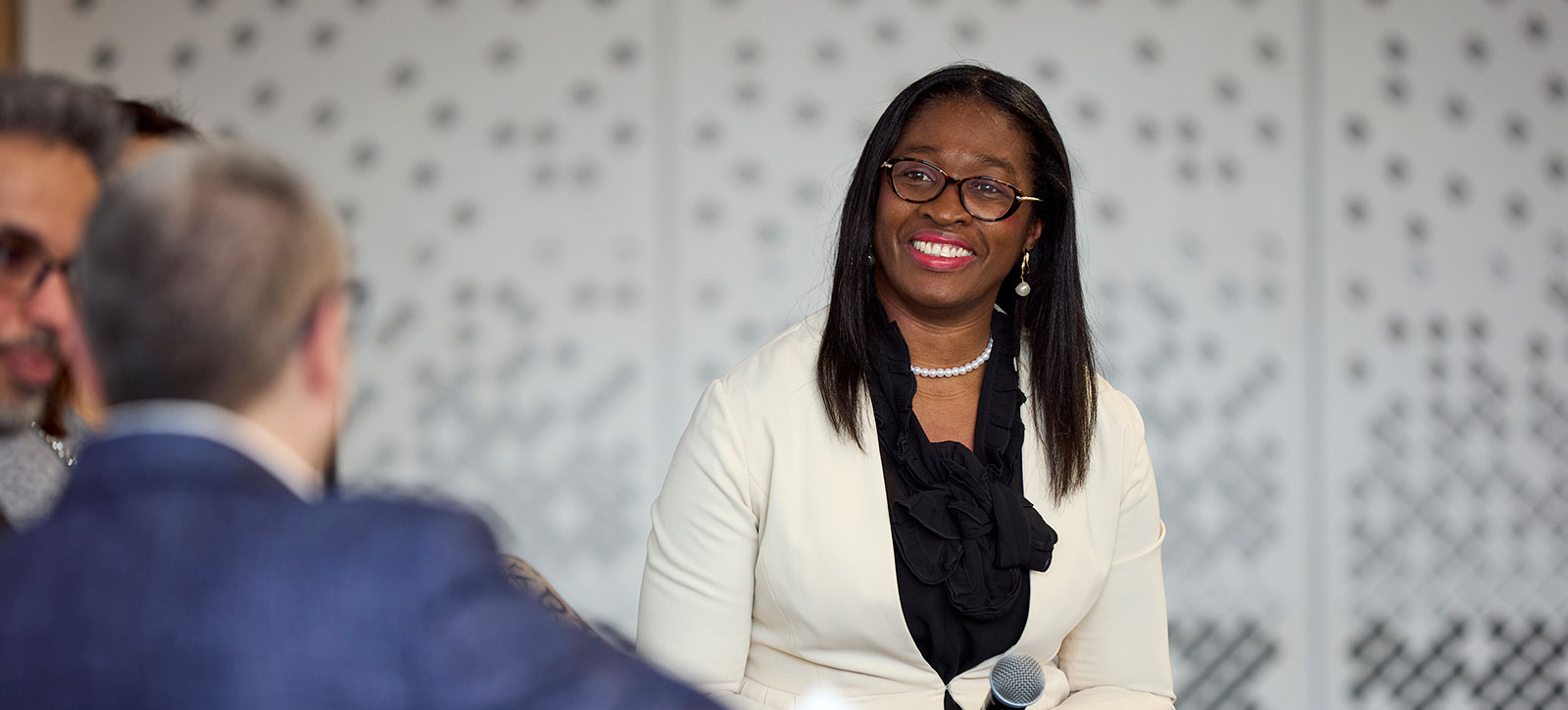
Meeting of minds: The programme's strength is the ability to generate new ideas
When delegates celebrate the tenth anniversary of Warwick Business School’s Doctorate of Business Administration (DBA) at a conference later this month, they will also be lauding 10 years of cutting-edge research.
“Great ideas emerge at interfaces, and the DBA has created just such an interface between the world of executives and academia,” said Christian Stadler, Professor of Strategic Management and DBA supervisor, who will be speaking at the annual DBA summit.
“I have observed it again and again with the students whose thesis I supervised. They came up with research ideas I had never thought of before; and, likewise, they hadn’t even imagined until they embarked on their thesis journey.”
The DBA, designed to match the academic rigour of a PhD while maintaining a focus on applied organisational impact, has produced a series of award-winning theses. Among them is the work of Surlina Yin (cohort three) whose research into the role of conversational AI in human capital management earned her the programme’s Best Thesis Award.
Philip Laque (cohort five) was similarly recognised for his study into how behavioural science can nudge consumers to choose plant-based food options in fast-food settings.
Applying research to practice
For Dr Yin, a specialist in human resources and technological innovation at US tech firm Oracle, the DBA represented more than a qualification.
“The doctorate transforms inquiry into a calling, entrusting participants with the profound duty of original discovery and the shaping of new futures,” she said.
“As doctors of business administration, we lead through the rigour of our methods, the humility of our pursuit, and the purpose behind every choice we make.”
Giovanni Radaelli, Reader in Operations Management and DBA Programme Director, said the programme’s mission has always been to equip senior professionals with the ability to shape the future of their organisations through rigorous inquiry, and the number of applications is always on the rise.
“It is inspiring that we have so many practitioners who recognise the importance of evidence-based research,” he said.
“And they are willing to spend at least four years doing doctoral research alongside their very complex and demanding jobs.”
Those professionals have come from every continent on the globe. More than 50 countries have been represented among the 10 cohorts, reflecting the School’s mission to build a genuinely international research community. One such alum is Swedish consultant Staffan Hedén (cohort three) whose thesis, supervised by Professor Stadler, ultimately led to the publication of his book – Business Model Innovation: How it really works – with a second volume on the way.
"I benefited greatly from being able to reflect on my existing knowledge of business and people, and this contributed to new creative angles generated together with my supervisor Professor Stadler," said Dr Hedén.
Women in business
Dr Radaelli also highlights the programme’s transformation in gender representation. Female participation has risen from just five per cent in the inaugural cohort in 2016 to a 55-60 per cent representation today – a shift he describes as “a very healthy indicator of equality”.
At last year’s DBA conference Peace Ani (cohort six) urged future female leaders in business to “have conviction, work hard and bring people along with you”.
Reflecting on her DBA experience before the conference this month, Dr Ani said: “The DBA has contributed significantly to my professional development by strengthening my capacity for advanced strategic thinking and evidence-based decision-making in the context of large-scale organisational transformation.
“The applied research skills developed through the programme, together with engagement with the high-calibre DBA community throughout and during the annual conference, have enhanced my ability to address complex, real-world problems and increased my credibility at board and senior stakeholder levels.”
Having recently launched a new consulting firm, she also anticipates “deriving further value from the DBA”.
Reviewing a decade of the DBA, Dr Radaelli said that the research of its candidates had not only been successful in addressing organisational challenges but has increased Warwick Business School’s impact on business and society.
This is borne out by increasing international attention being paid to its research. “We have received so much interest from international universities – from China, UAE, France, Hong Kong, and more,” he said.
“They are proactively contacting us to collaborate on different aspects of research that address real-world challenges.”
The goal of the Doctorate in Business Administration at WBS is to design organisational interventions which help address real-world business challenges.
Interested in applying?
Applications for the DBA are open until March 31, 2026. Book a one-to-one consultation with our DBA team to explore whether the programme is right for you and discuss next steps.
 X
X Facebook
 LinkedIn
 YouTube
 Instagram
 Tiktok