

Disruption: Executives and middle managers believe new technology and politics pose the biggest challenges
The ability to read and respond to a shifting environment has always been crucial for executives. This has become increasingly evident amid the volatility of recent years.
So, for the fourth year in a row, I asked business leaders what they expect to be the main challenge facing their organisation during the next 24 months. The survey was distributed to C-suite executives and middle managers in my Warwick Business School network.
It was important to include the latter, as companies will only be able to navigate emerging trends if the exec team is fully aligned with managers closer to the front line. If the C-suite's view of the world differs from that of the people working for them, the company will invariably struggle.
Of the 241 responses, 46 per cent were from senior executives and the remaining 54 per cent from middle managers and specialist staff.
The following three graphs summarize the most interesting insights from the survey.
1 Disruption created by AI and politics
There was a strong consensus that AI adoption and political disruption are the challenges that will have the biggest impact on businesses over the next year.
Two thirds of all respondents picked one of these two factors.
In both cases, the obvious question is, what is the best way for business leaders to respond?
In terms of AI adoption, companies are in vastly different stages. For those not at the forefront, there is no reason to panic.
Looking at the history of new technologies, it is clear that the main benefits derive from a second wave of innovation. The biggest winners will be those who are able to integrate these tools and adjust the way things are done.
In other words, don’t overthink what technology you should use. Instead, spend your energy on the question of how to best enable people to use AI and what processes need to be adjusted.
Finding the right response to political disruption is trickier, considering how unpredictable the consequences are.
In the US companies fully aligned with the current administration’s agenda – Palantir for example — have done well.
Another strategy is to beef up international business. Although tariffs have grabbed the headlines, international trade was up during the first half of 2025.
Another good way for Western executives to learn how to best navigate political minefields is to spend time with their counterparts in countries where governments have always taken a very active role in business.
2 How business challenges have shifted since 2022
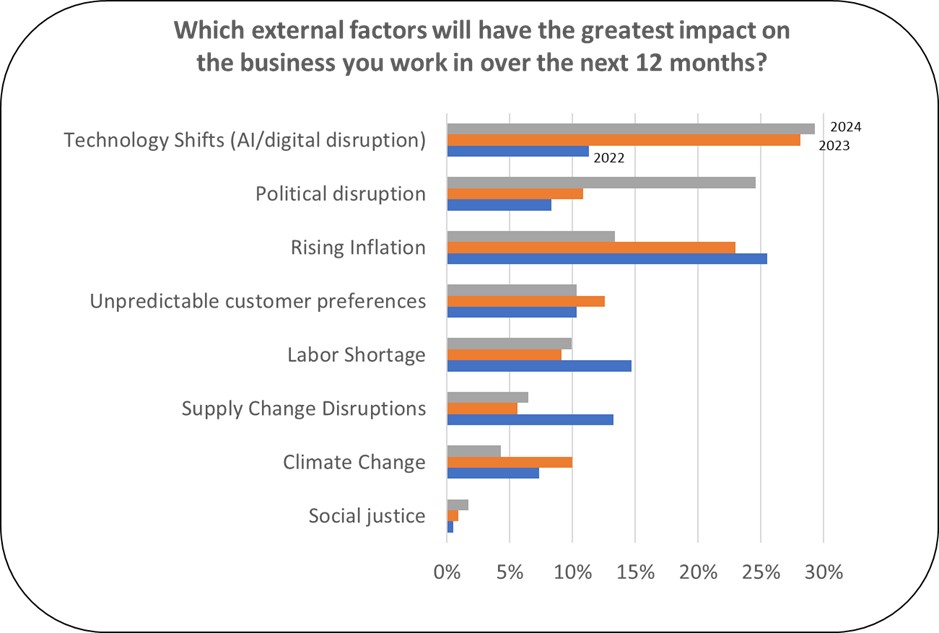
In the aftermath of Covid, the biggest worry for executives was rising inflation. Even though it continues to be high in many economies, companies have learned to adjust.
How to best deal with technology shifts became the top priority in 2023 and has remained there ever since, fuelled by the hype around generative AI.
More recently, political disruption has climbed the agenda since Donald Trump was re-elected as US President, as businesses grapple with the consequences of his political agenda.
The graph above is a useful illustration of how rapidly the world is changing. In 2022, politics was fifth on the list of challenges facing businesses, just one percentage point ahead of climate change.
It is possible that after the next presidential election in the US, it will become a secondary topic once more. But right now, that is hard to imagine.
3 Executives and middle managers have different priorities
In previous years, the priorities of the c-suite and middle managers have varied across different demographic groups, with geography and seniority playing a key role in shaping perspectives.
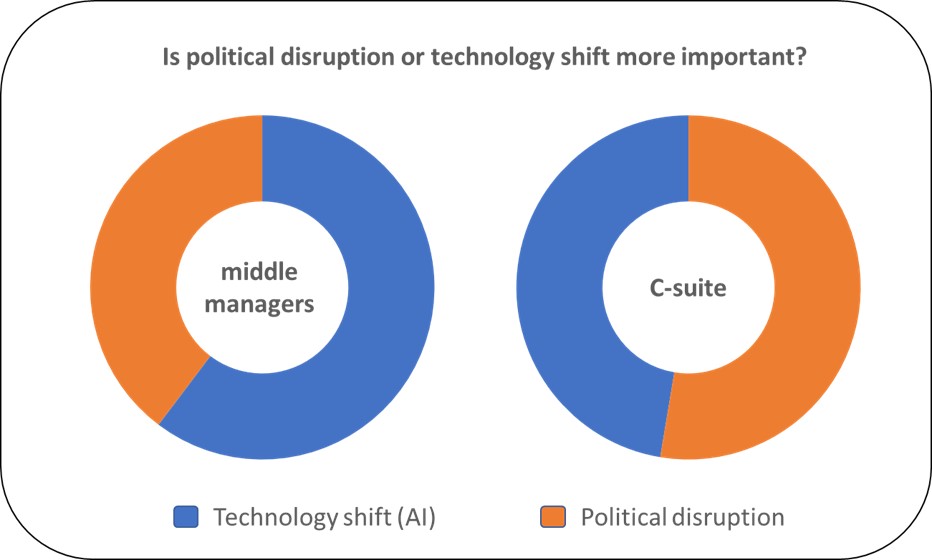
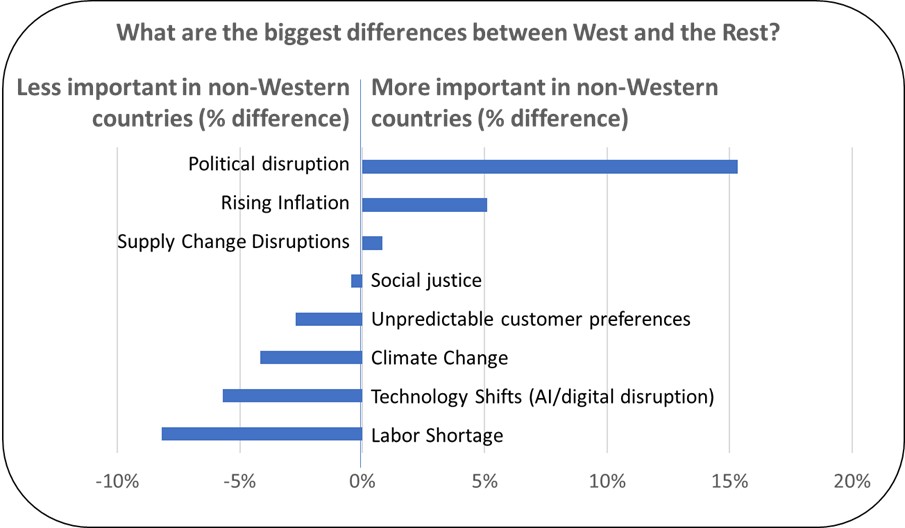
This year the results are consistent across geographical regions, but C-suite executives once again have different priorities to middle managers.
Political disruption is viewed as the biggest challenge by the former, while middle managers continue to see technology shifts as the great challenge facing their organisation.
This is a potential concern for business leaders. If executives and middle managers do not agree on their main priorities, it is likely that big plans will not be executed properly and the organisation will suffer.
In the current climate, there are two particular risks that business leaders should be aware of.
First, middle managers and frontline staff might worry that not enough time and money is being spent on AI.
Second, in a highly polarised political climate, those who do not agree with the government may feel strong enough to become demotivated – or even leave – if their leadership adopts a different ideological stance to their own.
How businesses should prepare for 2026
The obvious first step to mitigate these risks is for the executive team to find areas of consensus with middle managers and frontline staff.
There are a number of mechanisms that executives can use to involve staff in strategy making, such as open strategy. The book, Open Strategy, which I co-authored on the subject is an excellent starting point.
With complex topics such as politics, a workshop-based approach is sensible. Crucially, that does not mean taking a vote at the end of the process. However, a discussion of trends and strategic responses will enable those at the helm to take decisions that stick.
With technology shifts taking the top spot in my annual survey both this year and last, it is clear (and not surprising) that this should be on top of the executive agenda.
Generative AI and digital transformation represent an opportunity for all business leaders who can figure out how best to integrate this new technology into their organisation.
Those that do so successfully are likely to emerge as winners during the next 12 months.
This article is adapted from a piece originally written for Christian Stadler's Forbes channel.
Further reading:
Three steps to involve front line staff in open strategy
Four strategies to drive innovation in your organisation
Overcome three barriers to successful strategy
How middle managers help companies to change strategy
Christian Stadler is Professor of Strategic Management and teaches Strategic Advantage and Strategy and Practice on the Executive MBA and Global Online MBA.
Learn more about Open Strategy and how your company can thrive in a complex world with the four-day programme The Strategic Mindset of Leadership at WBS London at The Shard.
Discover more about Strategy and Organisational Change. Receive our Core Insights newsletter via email or LinkedIn.
 X
X Facebook
 LinkedIn
 YouTube
 Instagram
 Tiktok