


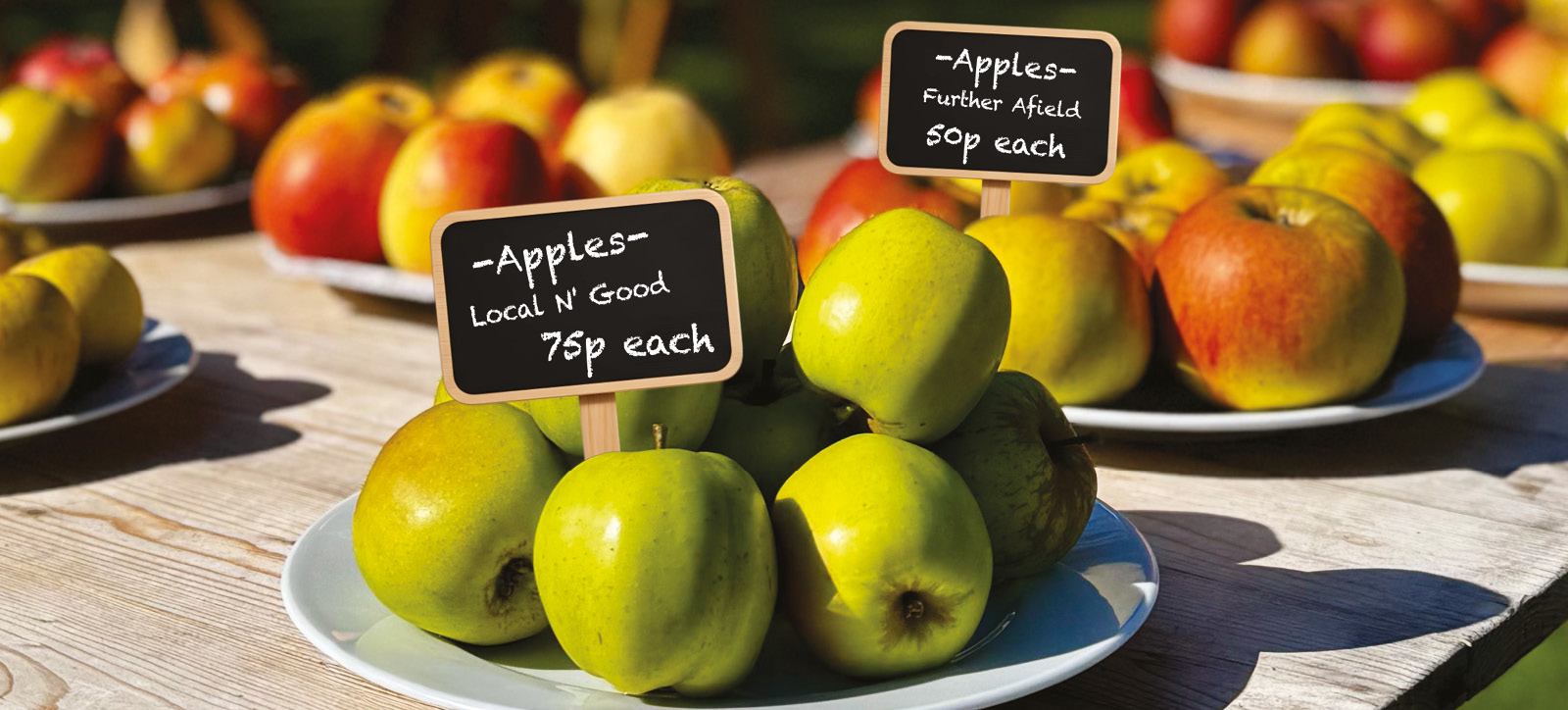
Pride of place: Tapping into a customer's sense of self-esteem can be an effective tool to market local produce
Imagine walking into a farmers’ market. Two baskets of apples catch your eye. One is labelled “Locally grown right here in [your town]”.
The other comes from a top farm further afield.
Both look delicious. Yet, you instinctively reach for the local ones – even if they cost more. Why?
Most people would say it’s because local produce is fresher, better for the environment or supports nearby farms. These are valid explanations. But they may not tell the full story.
My recent research with colleagues Matthew Meng at Huntsman Business School and Miguel Brendl at the University of Basel, published in Food Quality and Preference, uncovered something surprising: an individual’s self-esteem plays a crucial role in how much they value local food.
This insight opens new possibilities for promoting sustainable consumer behaviour, particularly in contexts where sustainability and concepts such as ‘local’ have become politically polarised.
People tend to identify with the place in which they live. Therefore, local food feels connected to their sense of self. It can carry personal meaning and this affects how people evaluate products.
What influences how we value products?
Our experiments show that positive self-evaluations can transfer to local products. When a product feels personal and people feel positive about themselves, they tend to value that product more.
We tested this idea in two experiments. The first was conducted in Switzerland.
Participants were offered a piece of chocolate, either locally produced or from a generic Swiss source.
Each participant was informed about the chocolate’s origin.
They were then asked to purchase the chocolate using the money they received for participating in the experiment.
Payments were made discreetly to eliminate social pressures.
All of the chocolate was identically wrapped, and participants made their payments before unwrapping it, ensuring that any differences in payment were due to the local versus non-local designation rather than taste or appearance.
Results indicated that participants paid more for the local option.
Crucially, this effect was stronger among those who strongly identified with the city where the study took place. These results support the idea that local identity increases the subjective value of local food by creating a product–self association.
How self-esteem affects what we buy
The second experiment was conducted online with US residents.
Participants imagined buying a pound of apples at a nearby grocery store. For some, the apples were described as locally grown; for others, they were not.
We also introduced a new element: subtly and temporarily reducing self-esteem in roughly half of the participants by asking them to reflect on personal shortcomings.
Among those participants, the local premium disappeared. They no longer valued local apples more than non-local ones. This suggests that the higher valuation of local products depends, in part, on the transfer of positive self-evaluations.
Together, these studies demonstrate not only that local food is valued more, but also that this premium is psychologically rooted in self-concept and identity.
Different ways to market sustainable goods
The findings gathered in our experiments have several implications for those interested in promoting sustainable consumption. Buying local is often presented as a value-driven decision that people make for environmental or ethical reasons.
Yet our findings suggest that it is also, quite literally, a personal choice. Consumers may not be aware of it, but how they feel about themselves, and how connected they feel to their geographical location, plays a role in what they are willing to pay for local products.
Consider how products are marketed. A typical message might state: “These apples are locally grown, reducing food miles”. A slightly different message could say: “These apples are from your community – grown where you live”.
Both are factually accurate. But the second frames the product as self-relevant. It recognises that people tend to favour things that feel like a part of themselves.
This shift in framing offers new tools to marketers and sustainability professionals. By emphasising identity, belonging, and personal connection, they can add depth to traditional appeals based on environmental impact or supply chain transparency.
This approach may even prove effective among consumers who are indifferent to environmental arguments because it draws on something more basic: the psychology of the self.
Harnessing identity in communications
There is already evidence that such approaches can be effective.
Appealing to people’s sense of social identity is now widely recommended as a key communication strategy in sustainability campaigns – by framing individuals as good citizens or responsible neighbours who take pride in their communities.
These examples reflect a broader insight: people are more likely to adopt sustainable behaviours when those actions align with their self-image or with how they wish to be perceived by others.
Of course, local is not always more sustainable. In some contexts, transporting food from more efficient producers elsewhere may have a lower environmental impact than growing it locally under less favourable conditions.
This makes it even more important to understand why local food feels better.
If part of the appeal stems from identity and self-association, then businesses and policymakers can consider how to replicate that sense of connection – whether the product is local or not.
Our findings suggest that people who feel good about themselves also tend to feel better about local products – and are more willing to pay for them.
This insight could be used not only to understand behaviour, but also to shape it by highlighting what is personally meaningful to the consumer, as well as what is good for the planet.
For instance, marketing campaigns might incorporate messages or experiences that briefly elevate self-esteem, perhaps by reminding consumers of their achievements, values, or community role.
These small cues could, in turn, increase the appeal of identity relevant sustainable products.
Ultimately, what benefits the self can also benefit the planet – if we design our strategies with both in mind.
Further reading:
How do you persuade people to buy sustainable goods?
Five strategies to succeed during the B2B sales revolution
How sustainable is your advent calendar?
Could Christmas gifts change your behaviour?
Özgün Atasoy is Associate Professor of Marketing at Warwick Business School. He teaches Consumer Insights for Marketing Decisions on the Full-time MBA, Executive MBA, Global Online MBA, and Global Online MBA (London). He also teaches Critical Issues in Marketing on the MSc Marketing & Strategy.
Learn to leverage the power of behavioural science and decision-making in your organisations with the three-day Executive Education programme Behavioural Science in Practice at WBS London at The Shard.
Discover more about Marketing and Behavioural Science. Receive our Core Insights newsletter via email or LinkedIn.
 X
X Facebook
 LinkedIn
 YouTube
 Instagram
 Tiktok